Research progress of artificial intelligence in high-throughput drug screening
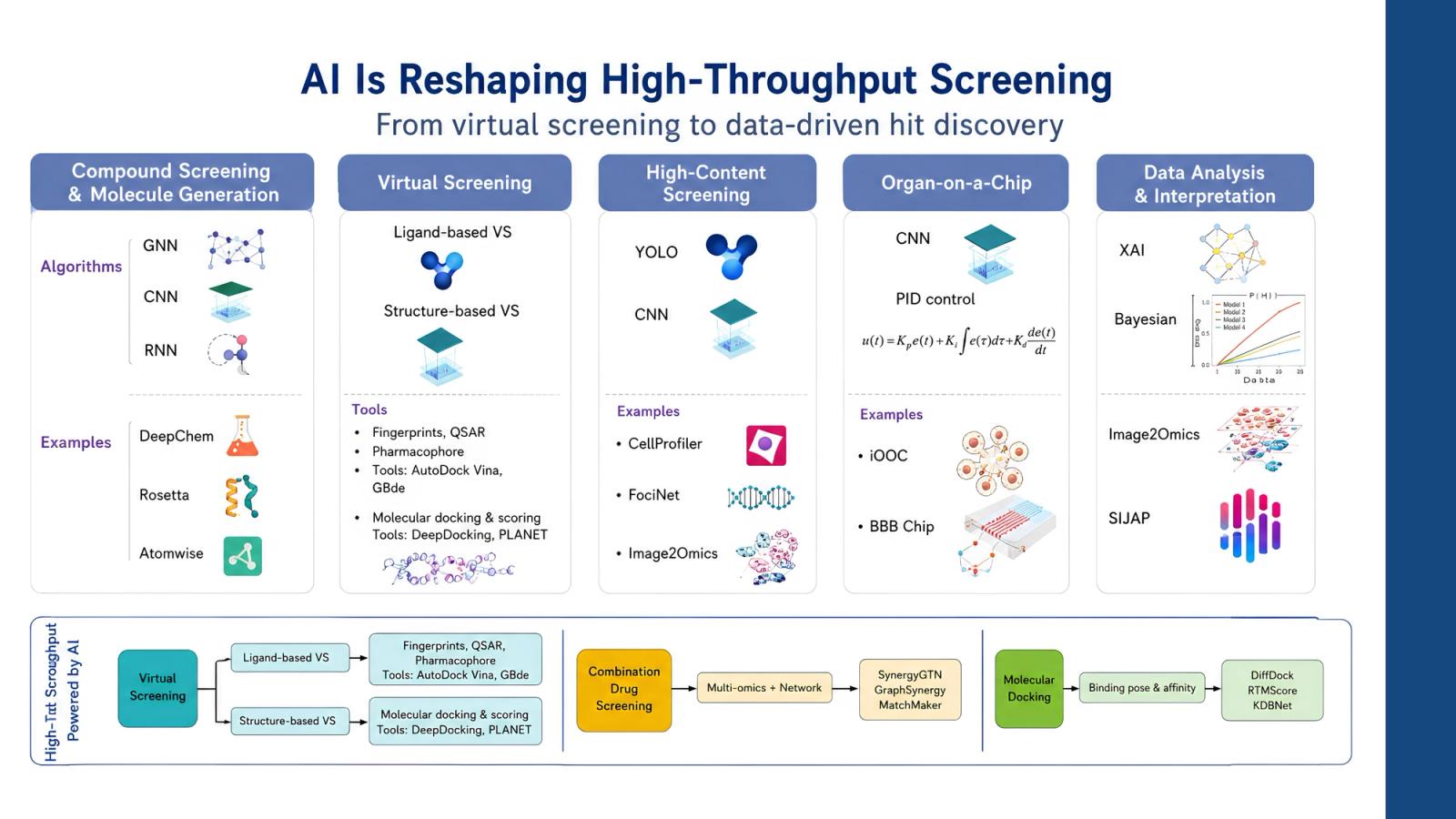
A recent review highlights how AI is becoming integrated across high-throughput screening, from virtual screening and molecular docking to image analysis and hit interpretation. Yet the impact of these tools still depends on the quality, diversity, and experimental relevance of the chemical space being explored.
High-throughput screening has long been a central tool in drug discovery, but growing compound collections and increasingly complex biological readouts are exposing the limitations of conventional workflows. A recent review by Liu and colleagues examines how machine learning and deep learning are being integrated across the HTS process — not only to prioritize compounds, but also to analyze high-content images, interpret multidimensional datasets, predict drug combinations, and support post-screening hit identification.
One of the clearest shifts is the move from exhaustive screening toward data-guided prioritization of chemical space. In ligand-based virtual screening, machine-learning models can learn relationships between molecular features and biological activity, while graph neural networks and other deep-learning approaches can capture more complex structure–property patterns. In structure-based workflows, AI-enhanced docking and scoring methods can reduce the number of compounds requiring detailed computation or experimental follow-up. The review highlights, for example, DeepDocking applied to 1.36 billion molecules from ZINC15, reporting up to 100-fold data reduction and 6,000-fold enrichment of high-scoring molecules.
AI is also expanding what can be extracted from the experiment itself. Deep-learning approaches are increasingly used in high-content screening to classify cellular phenotypes, correct batch effects, and detect subtle morphological responses that may be missed by fixed thresholds or single-endpoint analysis. Related strategies are being extended to organoids and organ-on-a-chip systems, while multimodal models aim to connect chemical structure, imaging, transcriptomic, proteomic, and other readouts. In this setting, AI is not simply accelerating hit selection; it is helping transform complex screening outputs into mechanistic hypotheses.
The review also makes clear that AI performance is inseparable from data quality and validation strategy. Poor dataset construction, data leakage, batch effects, and insufficiently rigorous cross-validation can inflate apparent model performance and weaken generalizability. The same principle applies upstream: computational prioritization can only explore the chemistry represented in the available compound set. For practical screening campaigns, this places renewed importance on experimentally accessible, well-characterized, and purposefully selected chemical collections.
For organizations building AI-guided or experimentally driven discovery workflows, the emerging opportunity is therefore not simply to screen more molecules, but to connect computational prioritization with the right physical compounds for testing. AKos supports this interface through screening compounds and configurable compound collections that can be selected around project-specific chemical and biological questions. As AI becomes more deeply embedded in HTS, the ability to translate predicted chemical space into experimentally testable libraries will remain a critical part of effective hit discovery.
Source: Liu X. et al. Research progress of artificial intelligence in high-throughput drug screening. Frontiers in Pharmacology 17, (2026).
DOI: 10.3389/fphar.2026.1847031.