Beyond the G-Loop: Molecular Glues Are Expanding the Kinase Degradation Landscape
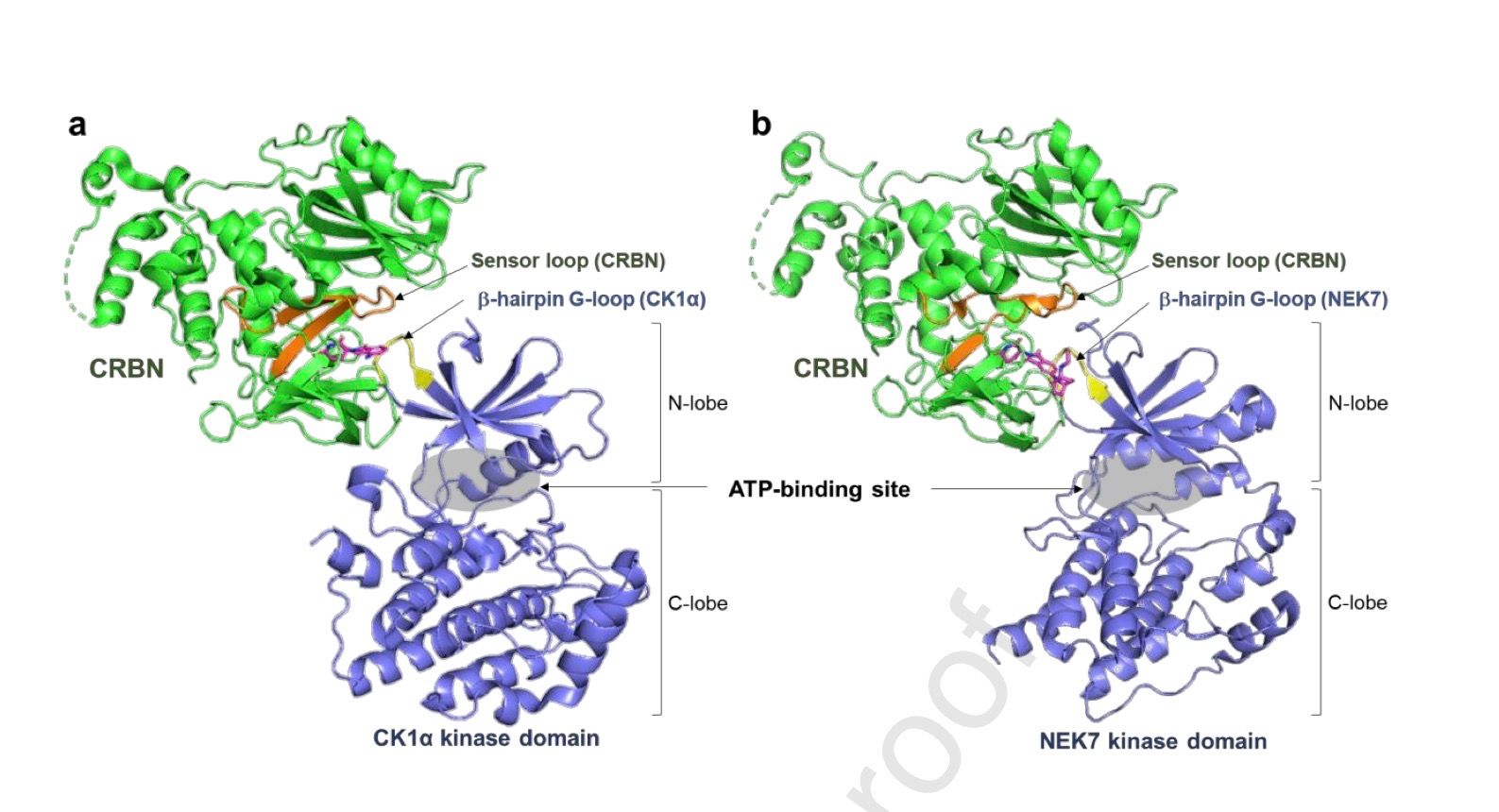
Historically, CRBN-mediated degradation has been associated with the recognition of relatively well-defined structural motifs, particularly the β-hairpin G-loop degron found in established neosubstrates such as CK1α. However, recent structural and proteomic studies demonstrate that CRBN can recruit a much broader range of kinase targets through substantially different molecular interfaces.
The expanding list of CRBN-compatible kinases now includes NEK7, WEE1, CDK2, CDK4, LCK, ALK, TBK1, PLK1, and IRAK1, alongside CK1α. Importantly, their recruitment does not necessarily depend on the presence of a conventional G-loop degron.
Different Kinases, Different Recognition Mechanisms
Structural studies have identified several previously unrecognized modes of kinase recruitment.
CDK2, for example, can be recruited through a noncanonical interface involving Glu57 in its αC helix. Cryo-EM analysis of the CRBN–B11–CDK2 complex revealed an extensive interaction network between this residue and the CRBN sensor loop. The resulting interface provides a structural explanation for selective CDK2 degradation over closely related kinases, including CDK1 and CDK3.
An alternative recognition mechanism has been identified for the Src-family kinase LCK. In this case, molecular glue recruitment involves an α-helical G-loop associated with the inactive kinase conformation. A related recognition motif has been structurally characterized in the mTOR FRB domain, indicating that G-loop recognition is not restricted to the classical β-hairpin architecture.
ALK provides another example of noncanonical recognition. The recently developed molecular glue degrader TRI-611 recruits ALK through a turn–helix surface within the C-lobe of its kinase domain, away from the ATP-binding pocket. This interface is poorly conserved among related kinases, contributing to the compound’s high degradation selectivity.
Perhaps one of the more unusual mechanisms has been reported for TBK1. The degrader CCT412020 recognizes a composite surface formed at the interface of the TBK1 homodimer. Rather than relying on a degron within an individual protein, productive recruitment depends on structural features created by protein assembly.
A related concept is emerging for CDK4, where the molecular glue NE26394 preferentially degrades CDK4 associated with INK4 family proteins. Although the precise binding geometry remains unresolved, these findings suggest that the composition of protein complexes may determine their susceptibility to molecular glue-mediated degradation.
Together, these examples demonstrate that CRBN recognition is governed by more than individual degron motifs. The accessibility of the target surface, its conformational state, and the geometry of the ternary complex all contribute to productive recruitment.
Implications for Drug Discovery
The therapeutic relevance of these discoveries extends beyond the ability to degrade additional kinase targets.
Unlike conventional ATP-competitive inhibitors, molecular glue degraders can eliminate both the catalytic and noncatalytic functions of a kinase. This distinction is particularly relevant for proteins that contribute to cellular signaling through scaffolding or other kinase-independent activities.
Recruitment through interfaces outside the ATP-binding pocket may also provide a way to address resistance mutations that reduce the efficacy of existing kinase inhibitors.
TRI-611 illustrates this potential. In preclinical studies, the compound demonstrated activity against several ALK inhibitor-resistant mutants, including the challenging L1196M/G1202R combination. Its brain penetration and antitumor activity in intracranial models are particularly relevant to ALK-positive non-small cell lung cancer with central nervous system involvement. The review reports that TRI-611 has advanced into Phase 1/2 clinical evaluation.
Selective CDK2 degradation represents another promising approach, particularly in tumors where cyclin E–CDK2 signaling contributes to resistance to CDK4/6 inhibition. The molecular glue MRT-51443 has demonstrated selective CDK2 degradation and encouraging activity in preclinical breast cancer models, including combinations with ribociclib and fulvestrant.
Nevertheless, the relationship between degradation efficiency and biological response is not always straightforward. The selective NEK7 degrader NK7-902 achieves near-complete target degradation in primary human monocytes, yet inhibition of NLRP3 inflammasome-dependent IL-1β release remains partial and strongly dependent on the experimental context. These observations highlight the importance of evaluating downstream pathway responses alongside target degradation.
Towards More Rational Molecular Glue Design
Beyond identifying new kinase targets, the reviewed studies provide valuable insights into molecular glue design.
Small changes in ligand structure can substantially alter neosubstrate selectivity by modifying contacts at the CRBN–target interface. Recent evidence also indicates that CRBN itself is conformationally dynamic, adopting open, intermediate, and closed states that differ in their ability to support recruitment of particular substrates.
The identification of allosteric CRBN ligands further demonstrates that modulation of these conformational states can selectively enhance or suppress degradation of different neosubstrates.
These findings have direct implications for medicinal chemistry and screening strategies. Rather than focusing exclusively on ligand affinity for CRBN, molecular glue optimization increasingly requires consideration of ternary-complex geometry, protein conformational dynamics, and proteome-wide selectivity.
Advances in structural biology, quantitative proteomics, and computational modeling are making these interactions more accessible to systematic investigation. At the same time, the structural complexity of ternary complexes continues to present substantial challenges for predictive molecular design.
The studies summarized in this review suggest that kinase-targeting molecular glues are progressing from largely empirical discovery toward more structure-informed development. Although most candidates remain at the preclinical or early clinical stage, the growing diversity of recognized kinase interfaces provides a broader foundation for discovering selective degraders and exploring therapeutic mechanisms beyond conventional kinase inhibition.
Reference
Hwang, I.; Hur, W. Recent discoveries of CRBN-binding molecular glue degraders: Focus on protein kinases. Bioorganic & Medicinal Chemistry (2026), journal pre-proof.
https://doi.org/10.1016/j.bmc.2026.118821