Can a DNA-binding interface become a starting point for covalent drug discovery?
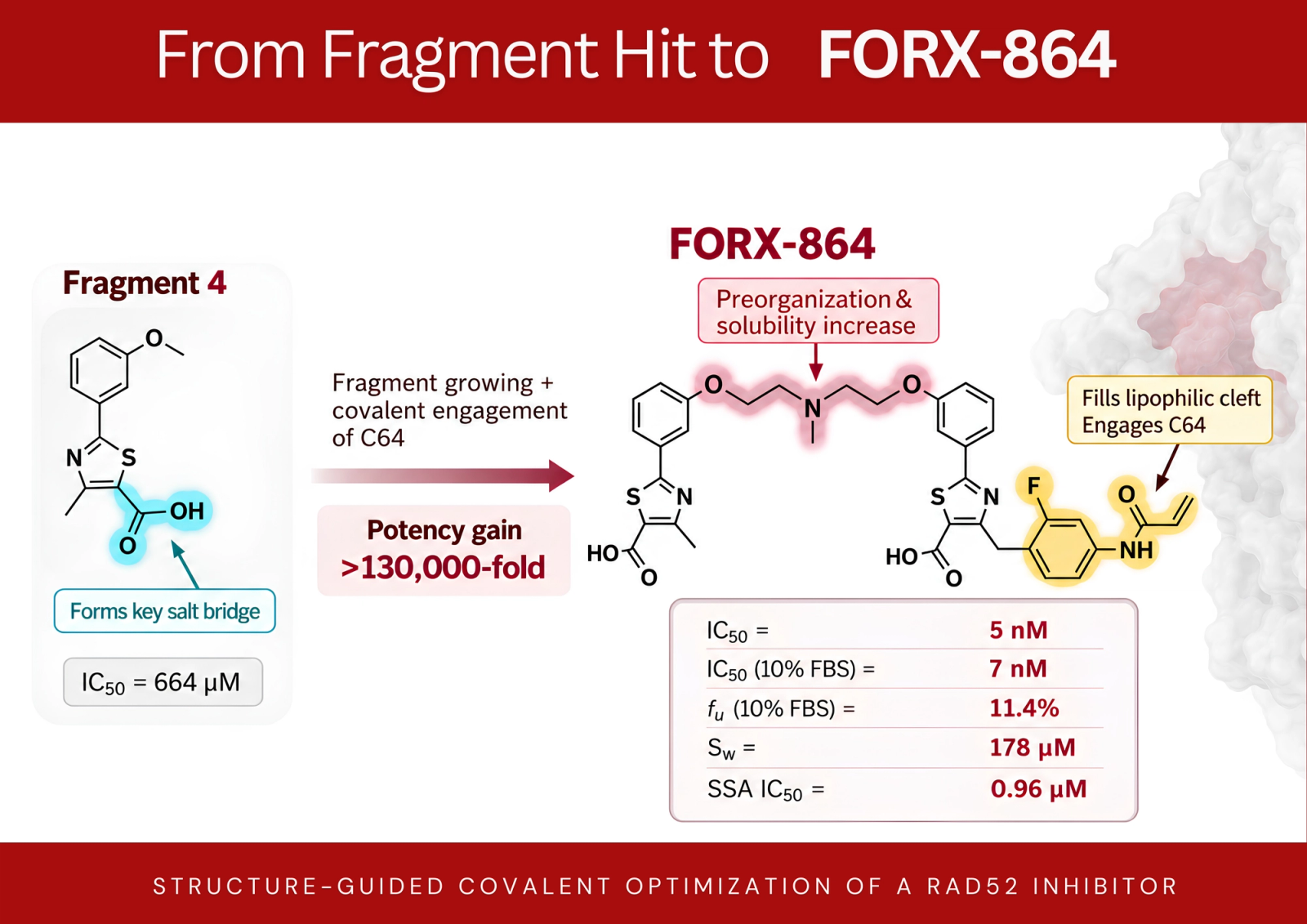
The recent JACS publication from FoRx Therapeutics suggests that it can — and the chemistry is particularly interesting. RAD52, a DNA repair protein, has a broad, polar, solvent-exposed DNA-binding groove rather than a conventional small-molecule pocket. The researchers approached this problem by screening carboxylate-containing fragments capable of mimicking interactions normally made by the DNA phosphate backbone. Crystallography revealed two fragments occupying adjacent nucleotide-binding positions. Linking these fragments dramatically improved affinity, while further structural optimization identified C64 as an opportunity for covalent engagement. Introducing an acrylamide warhead eventually led to FORX-864, with low-nanomolar biochemical potency and submicromolar inhibition of RAD52-dependent single-strand annealing in cells.
The most interesting aspect is how the covalent interaction was engineered. Rather than relying on a highly reactive electrophile to find a nucleophilic residue, the authors first established molecular recognition and then positioned the warhead to capture a specific cysteine. FORX-864 achieves a reported k_inact/K_I of approximately 230,000 M⁻¹s⁻¹. This combination of fragment linking, conformational preorganization and proximity-driven covalent chemistry offers an attractive strategy for other difficult protein–nucleic acid interfaces, provided an appropriately positioned nucleophile is available.
There is also an intriguing connection to targeted protein degradation. A ligand that recognizes a previously inaccessible surface could provide an anchoring point for recruiting an E3 ligase, potentially extending TPD to DNA-binding proteins that lack conventional ligandable pockets. However, converting FORX-864 itself into a PROTAC would be far from straightforward. Irreversible covalent attachment to the target can compromise degrader recycling, while productive ternary-complex formation depends on much more than target affinity. Exploring the reversible precursor or designing a reversible covalent warhead might therefore be more promising than simply attaching an E3 ligand to the existing inhibitor. The structural information could also help identify suitable linker attachment positions.
The chemistry also raises some important developability questions. FORX-864 is already a beyond-rule-of-5 molecule with two carboxylic acid groups, making passive permeability and oral delivery challenging. Adding a PROTAC linker and E3 ligand would only increase that burden. The difference between biochemical and cellular potency deserves attention, as do intracellular target occupancy, proteome-wide selectivity and the possibility of binding other nucleic acid-binding proteins. Even with encouraging covalent engagement and cellular activity, translating this chemistry into an effective therapeutic will require substantial optimization.
What I find particularly valuable is the possibility of using DNA-mimetic recognition to discover binding sites, with covalent chemistry providing the additional stabilization needed to make them pharmacologically useful. Whether the resulting molecules become inhibitors, degraders or simply better chemical probes, this approach opens interesting directions for targets that medicinal chemists have traditionally struggled to address.
Bocquet et al., Journal of the American Chemical Society (2026).
https://doi.org/10.1021/jacs.6c16278