
Complementary KIT Inhibition in Imatinib-Resistant Gastrointestinal Stromal Tumours
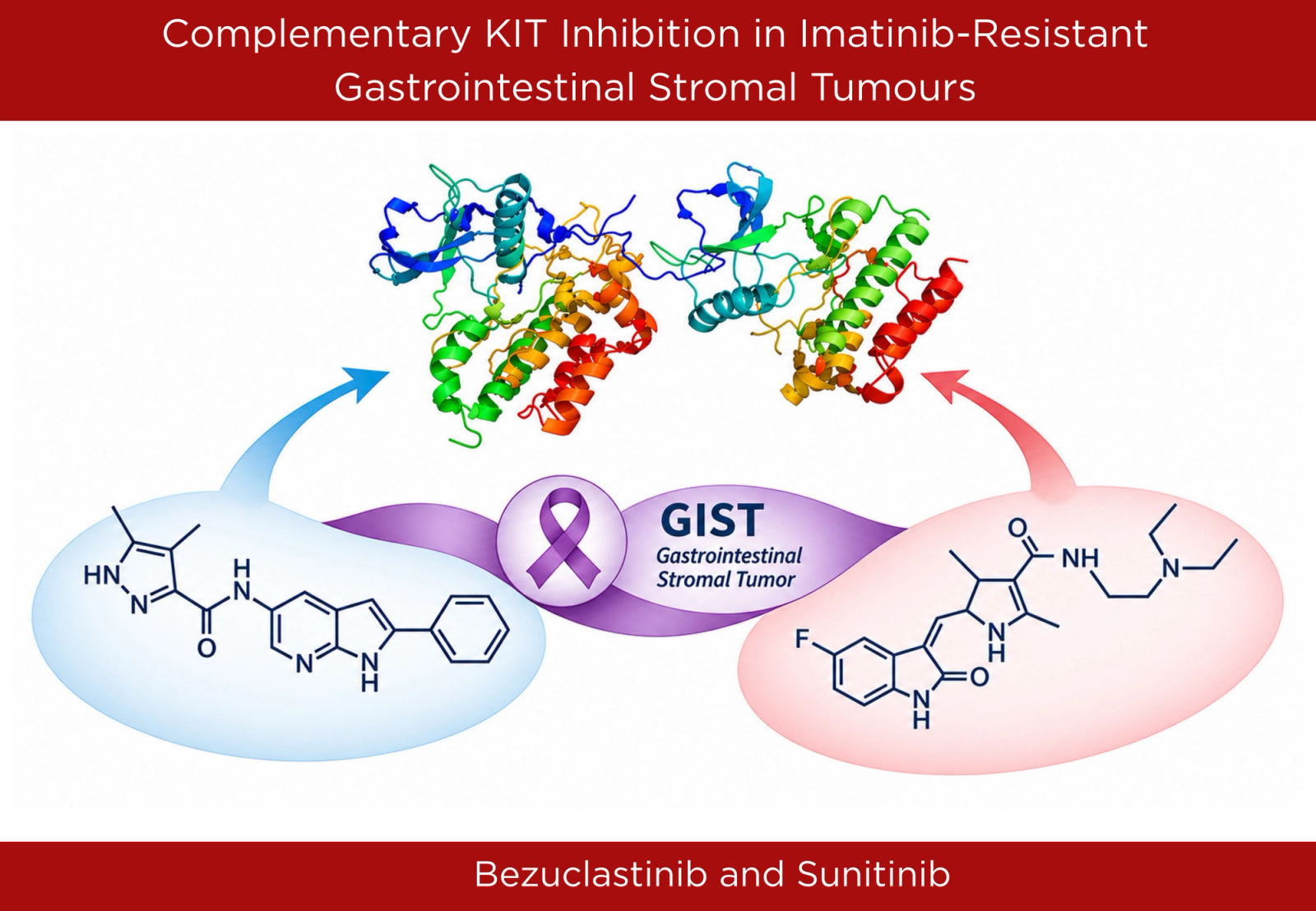
On 24 November 2026, the US Food and Drug Administration (FDA) approved Ekitna (bezuclastinib), developed by Cogent Biosciences, in combination with sunitinib for adults with advanced gastrointestinal stromal tumours (GIST) who have previously received imatinib. It is the first new treatment approved in this clinical setting in more than two decades.
When the target remains the same, but the binding pocket changes.
GIST is a mesenchymal tumour of the gastrointestinal tract thought to originate from the interstitial cells of Cajal or their precursors. In most cases, tumour growth is driven by activating mutations in KIT, a receptor tyrosine kinase. Under physiological conditions, KIT activation is regulated by stem cell factor. Oncogenic mutations can disrupt this regulation, maintaining intracellular signalling that promotes cell proliferation and survival.
The introduction of imatinib fundamentally changed the treatment of advanced GIST. However, prolonged exposure to the inhibitor creates selective pressure under which resistant tumour cell populations can expand. Secondary mutations frequently emerge in two particularly important regions of KIT: the ATP-binding pocket, encoded by exons 13 and 14, and the activation loop, encoded by exons 17 and 18.
Several resistant variants can coexist within the same patient, sometimes even within individual tumour lesions. An inhibitor that effectively suppresses one tumour cell population may have considerably weaker activity against another. Consequently, resistance does not necessarily mean that KIT has ceased to be a relevant therapeutic target. Rather, the molecular and conformational properties of the target have changed in ways that an existing inhibitor may no longer accommodate. [3]
Bezuclastinib, originally developed as PLX9486 and subsequently known as CGT9486, is a selective type I KIT inhibitor with activity against clinically relevant activation-loop mutations. Its development illustrates the importance of considering protein conformational dynamics alongside conventional structure–activity relationships.
Protein kinases are conformationally dynamic enzymes. The conserved aspartate–phenylalanine–glycine (DFG) motif participates in organising the catalytic machinery and changes its orientation as the kinase transitions between different conformational states. Type I inhibitors generally recognise the active-like DFG-in conformation, whereas type II inhibitors bind to an extended pocket associated with the inactive DFG-out state.
Activation-loop mutations, particularly KIT D816V, can favour an active kinase conformation, reducing susceptibility to inhibitors that preferentially recognise the inactive state. The development of bezuclastinib addressed this conformational limitation.
The molecule contains a substituted 7-azaindole scaffold connected through an amide linkage to a dimethylpyrazole moiety, with a phenyl substituent extending from the fused heterocyclic system. Azaindoles are particularly attractive scaffolds in kinase inhibitor discovery because their hydrogen-bond donor and acceptor arrangement can support recognition of the kinase hinge region.
In bezuclastinib, the arrangement of these structural elements supports recognition of mutant KIT in a conformation that differs from those preferentially targeted by conventional type II inhibitors. Its therapeutic relevance therefore cannot be explained simply by its affinity for KIT. The spectrum of KIT variants it inhibits is equally important. [3]
Two inhibitors directed against one kinase. Combining two drugs that inhibit the same kinase may initially appear redundant. In resistant GIST, however, the rationale is compelling. Bezuclastinib has activity against primary KIT mutations and secondary activation-loop mutations, while sunitinib provides complementary coverage of several resistance mutations affecting the ATP-binding region.
Sunitinib is structurally distinct from bezuclastinib. Its fluoro-substituted oxindole scaffold, conjugated pyrrole system and basic diethylaminoethyl side chain form part of a multikinase inhibitor with an established clinical role in GIST. Its activity extends beyond KIT to several other receptor tyrosine kinases. Nevertheless, its ability to inhibit certain KIT ATP-binding-pocket mutants is particularly relevant to this combination.
The experimental and early clinical rationale for combining conformation-specific KIT inhibitors was established before the pivotal Phase III trial. Clinical investigations incorporating circulating tumour DNA analysis provided evidence consistent with complementary activity against different KIT mutant subpopulations. [3]
This approach suggests that the pharmacological properties of a compound should sometimes be evaluated in relation to its intended combination partner. An inhibitor with a complementary mutation profile may offer greater therapeutic value in a specific combination than one designed simply to maximise the number of kinases it inhibits. This distinction is particularly important in oncology, where acquired resistance can produce a heterogeneous population of tumour cells that remain dependent on the same signalling pathway but respond differently to individual inhibitors.
From molecular design to clinical benefit. The FDA approval was supported by PEAK (NCT05208047), an international, randomised Phase III study involving 413 patients with advanced GIST following disease progression on imatinib or intolerance to the drug. The trial compared bezuclastinib plus sunitinib with sunitinib alone.
Median progression-free survival was 16.5 months in patients receiving the combination, compared with 9.2 months in those receiving sunitinib alone. The hazard ratio for disease progression or death was 0.50 (95% confidence interval, 0.39–0.65; p < 0.0001). An objective tumour response was observed in 46% and 26% of patients, respectively. [1,2,4]
These findings are particularly important because the combination was evaluated against an established active treatment rather than placebo. The study thus provides direct clinical evidence that broadening the coverage of resistant KIT variants through combined kinase inhibition can improve treatment outcomes. Overall survival data remained immature at the time of approval. The demonstrated improvement in progression-free survival should therefore not be interpreted as established evidence of longer overall survival.
For patients living with advanced GIST, disease progression after imatinib represents a difficult stage of treatment. Subsequent therapeutic options remain limited, and the duration of disease control can decrease as additional resistance mechanisms emerge. The availability of a treatment that significantly extends progression-free survival after imatinib is therefore clinically meaningful. The higher objective response rate also indicates that a greater proportion of patients experienced measurable tumour shrinkage, although radiological responses should not automatically be equated with symptom relief or improved quality of life.
The benefits of combined kinase inhibition must nevertheless be considered alongside its toxicity. Ekitna carries an FDA boxed warning for hepatotoxicity. Liver function monitoring is required before and during treatment, and clinically significant abnormalities may necessitate treatment interruption, dose reduction or discontinuation. The prescribing information also identifies embryo-fetal toxicity as an important safety consideration. [1,2]
Cogent Biosciences has announced the commercial availability of Ekitna in the United States, accompanied by a patient support programme intended to help patients and healthcare professionals address barriers to treatment access. [2]
Future kinase inhibitor discovery. The development of bezuclastinib offers a useful perspective on the relationship between chemical structure, protein conformation and acquired drug resistance. Kinase selectivity is often described through panels of biochemical inhibition values, yet these measurements alone cannot fully capture the pharmacological diversity of clinically relevant mutant proteins. A more informative discovery strategy may involve systematic profiling against resistance-associated variants, structural characterisation of their conformational preferences and early evaluation of inhibitors in rational combinations. Such an approach could be particularly valuable in cancers where several resistant tumour cell populations remain dependent on different molecular forms of the same oncogenic kinase. Rather than attempting to accommodate every resistance mutation within a single chemical scaffold, complementary inhibitors may provide a practical alternative.
The broader applicability of this strategy will depend on the biology of each target, the resistance mechanisms involved and the tolerability of sustained combined inhibition. Bezuclastinib nevertheless provides clinical validation of an important therapeutic concept: heterogeneous resistance can be addressed through complementary pharmacological recognition of a single molecular target.
References
- US Food and Drug Administration. FDA approves bezuclastinib in combination with sunitinib for advanced gastrointestinal stromal tumors. 24 November 2026.
Official FDA approval announcement. - Cogent Biosciences. Cogent Biosciences Announces FDA Approval and Launch of EKITNA™ (bezuclastinib) for the Treatment of Patients with Gastrointestinal Stromal Tumors (GIST) Who Have Received Prior Treatment with Imatinib. 24 November 2026.
Company press release. - Wagner AJ, et al. Association of Combination of Conformation-Specific KIT Inhibitors With Clinical Benefit in Patients With Refractory Gastrointestinal Stromal Tumors: A Phase 1b/2a Nonrandomized Clinical Trial. JAMA Oncology. 2021.
DOI: 10.1001/jamaoncol.2021.2086. - Cogent Biosciences. Cogent Biosciences Announces FDA Acceptance of New Drug Application (NDA) with Priority Review for Bezuclastinib in Combination with Sunitinib for Patients with GIST. 28 May 2026.
Company press release and Phase III results. - A Phase III Study of Bezuclastinib in Combination With Sunitinib in Patients With Gastrointestinal Stromal Tumours.
Clinical trial NCT05208047.