
Covalent Tryptoline Stereoprobes Target GRPEL1–HSPA9: Molecular Recognition Beyond Conventional Binding Pockets
Distal modifications reshape covalent protein engagement
In a recent Nature Chemical Biology study, Hayward, Berkeley and colleagues investigated how modifications distant from an electrophilic group influence covalent ligand recognition.
The researchers examined tryptoline acrylamides, a class of stereochemically defined compounds previously shown to engage cysteine residues across the human proteome.
Rather than changing the acrylamide warhead, they introduced different substituents at the C6 and C7 positions of the tryptoline scaffold. Four chemical groups were explored: phenylacetylene, benzodioxole, fluorophenyl ether and N-methyl triazole.
The resulting library contained 32 compounds organized into eight sets of four stereoisomers. This design enabled systematic assessment of substituent identity, position and stereochemistry while retaining the same electrophilic functionality.
Using cysteine-directed activity-based protein profiling (ABPP) in Ramos human B-lymphoid cancer cells, the researchers quantified 24,830 cysteine sites across 7,714 proteins.
The elaborated compounds stereoselectively engaged 95 cysteine sites. Of these, 54 showed preferential engagement by elaborated probes compared with their parent compounds.
Many interactions depended strongly on whether the substituent occupied the C6 or C7 position, its chemical identity and the stereochemical configuration of the compound.
Non-electrophilic analogues generally showed little measurable engagement, indicating that covalent bond formation remained important for interaction potency.
The results demonstrate that modifying recognition elements distant from an electrophilic warhead can substantially alter proteomic selectivity without changing the reactive group itself.
One of the most informative findings involved GRPEL1, a mitochondrial nucleotide exchange factor that regulates the HSP70 chaperone HSPA9, also known as mortalin.
The GRPEL1–HSPA9 complex participates in mitochondrial protein import, folding and protein homeostasis.
Two C7-phenylacetylene stereoprobes, WX-71b and WX-71c, demonstrated stereoselective engagement of GRPEL1 C124.
The researchers selected WX-71b for detailed characterization. In a competitive gel-ABPP assay, WX-71b inhibited GRPEL1 probe labeling with an IC₅₀ of 2.3 µM.
The inactive enantiomer WX-71d did not reproduce this engagement, while mutation of C124 to alanine abolished the relevant probe interaction.
Previously determined cryo-EM structures place GRPEL1 C124 near the interface with HSPA9, suggesting that covalent modification could interfere with complex formation.
Immunoprecipitation experiments followed by mass spectrometry and western blotting confirmed that WX-71b disrupted the GRPEL1–HSPA9 interaction in cells.
This effect was stereoselective, depended on C124 and persisted for up to 24 hours under the experimental conditions.
Additional experiments showed that HSPA9 binding prevented covalent engagement of GRPEL1 by the reporter probes, consistent with the location of C124 near the protein interface.
Interestingly, WX-71b did not measurably engage the related mitochondrial nucleotide exchange factor GRPEL2, despite conservation of the corresponding cysteine. Experiments using a GRPEL2 chimera implicated the surrounding protein sequence in determining ligand recognition.
Although the precise structure of the WX-71b–GRPEL1 covalent complex remains unresolved, the combined biochemical, mutational and cellular evidence supports a mechanism involving modification of C124 and disruption of the GRPEL1–HSPA9 interaction.
The researchers next examined whether disrupting the complex affected mitochondrial function. In HCT-116 cells, WX-71b impaired mitochondrial import of a fluorescent reporter protein. This effect was not reproduced by the inactive enantiomer and was substantially reduced in cells expressing the C124A-GRPEL1 mutant.
Importantly, WX-71b did not produce detectable mitochondrial membrane depolarization under the conditions tested, suggesting that the observed import defect was not simply caused by a collapse of membrane potential.
Pulse-chase SILAC proteomics independently demonstrated reduced accumulation of newly synthesized proteins in mitochondria, particularly affecting proteins associated with the mitochondrial matrix and inner membrane.
WX-71b also decreased basal and maximal mitochondrial respiration and increased expression of the integrated stress response markers ATF4 and CHOP.
These effects were attenuated in cells expressing C124A-GRPEL1, further supporting the involvement of the identified covalent interaction.
Using an mt-mKeima reporter, the researchers additionally observed an increased mitophagy index following WX-71b treatment.
However, this result does not establish whether the compound increases complete mitophagic flux or affects downstream degradation processes.
Together, these experiments connect covalent modification of GRPEL1 to mitochondrial protein import defects, altered respiration and changes in cellular stress and quality-control signaling.
Experimental ligandability versus AI cofolding predictions
An additional component of the study examined whether computational methods could reproduce the experimentally identified protein–ligand interactions.
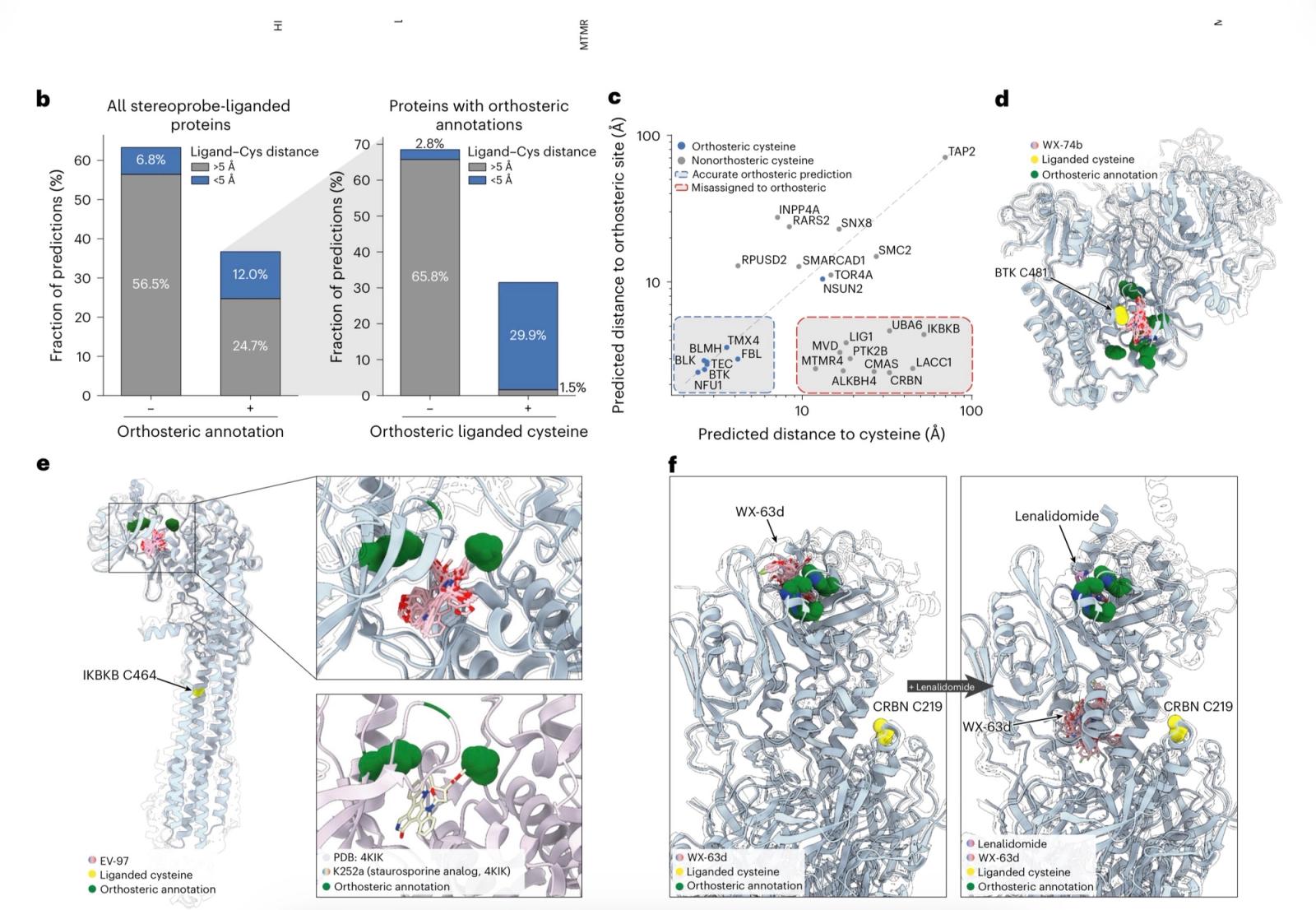
The authors evaluated Boltz-2 using 102 proteins and 171 protein–ligand pairs. A prediction was considered successful when the modeled ligand was positioned within 5 Å of the experimentally engaged cysteine.
Only 23 of 102 proteins yielded at least one prediction meeting this criterion.
Successful predictions were concentrated around established orthosteric pockets. For nonorthosteric interactions, the model frequently positioned compounds in familiar binding sites rather than near experimentally identified cysteine residues.
For example, Boltz-2 placed a stereoprobe in the ATP-binding pocket of IKBKB despite experimental engagement of C464, located more than 20 Å away.
A similar discrepancy occurred with CRBN, where the model favored the conventional ligand-binding pocket instead of the experimentally engaged C219 region.
The authors refer to this tendency as orthostery burnout. Their findings suggest that current cofolding methods may favor binding environments well represented in structural datasets, limiting their ability to identify previously uncharacterized nonorthosteric sites.
This limitation is relevant to covalent ligand discovery, particularly for protein–protein interfaces and other binding environments that are poorly represented by conventional ligand-bound structures.
Implications for covalent compound design
The study extends earlier work on tryptoline acrylamides by connecting systematic chemical diversification to a defined biological mechanism.
Substituent modifications distant from an electrophile can redirect protein recognition and reveal previously uncharacterized ligandable sites. Stereochemical diversity can provide both new screening opportunities and closely related control compounds for mechanistic experiments.
The GRPEL1 results also demonstrate the importance of following proteomic hit identification with site-directed mutagenesis, orthogonal biochemical assays and cellular functional studies.
WX-71b remains a research probe rather than an optimized therapeutic candidate. Its precise binding geometry, pharmacological selectivity and suitability for further development require additional investigation.
Nevertheless, the work establishes a direct connection between tryptoline scaffold modification, selective covalent engagement of GRPEL1 C124 and disruption of a mitochondrial protein complex.
For focused covalent library design, the study provides experimental evidence that systematic diversification of molecular recognition elements - not only electrophilic warheads—can uncover functional protein interactions that remain difficult to predict computationally.
References
Primary publication
Hayward, R. E., Berkeley, R. F., Gao, Z. et al. Tryptoline stereoprobe elaboration identifies inhibitors of the GRPEL1–HSPA9 complex. Nature Chemical Biology (2026). DOI: 10.1038/s41589-026-02348-1
Related research
Njomen, E. et al. Multi-tiered chemical proteomic maps of tryptoline acrylamide–protein interactions in cancer cells. Nature Chemistry 16, 1592–1604 (2024). DOI: 10.1038/s41557-024-01601-1
Morizono, M. A. et al. Structural insights into GrpEL1-mediated nucleotide and substrate release of human mitochondrial Hsp70. Nature Communications 15, 10815 (2024). DOI: 10.1038/s41467-024-54499-1
Goetzke, F. W. et al. Complexoform-restricted covalent TRMT112 ligands that allosterically agonize METTL5. Nature Chemical Biology 22, 770–782 (2026). DOI: 10.1038/s41589-025-02099-5