
FDA Drug Approvals in Q3 2026: When Molecular Glues, Macrocycles and Precision Medicine Meet Clinical Reality
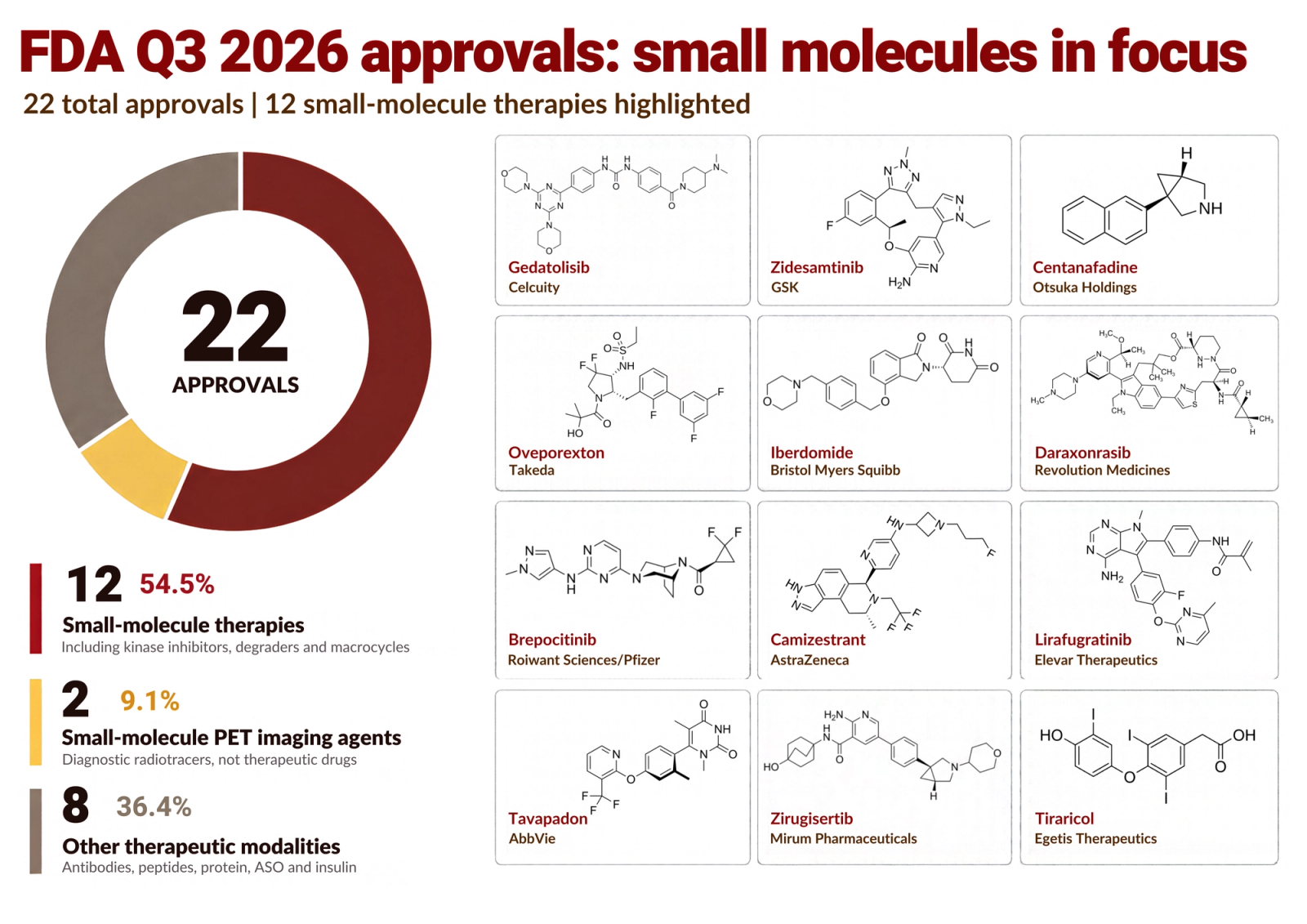
Small molecules remain the largest single group among Q3 2026 FDA approvals, but the distribution is no longer overwhelmingly in their favor. Of the 22 newly approved products, 12 are small-molecule therapeutics, two are small-molecule PET imaging agents, and eight belong to other modalities, including monoclonal antibodies, therapeutic peptides, a fusion protein, an antisense oligonucleotide, and a long-acting insulin. Excluding diagnostic agents, the split is 60% small molecules versus 40% alternative modalities. This does not indicate a decline in the importance of small-molecule drugs. Rather, it reflects the increasingly substantial contribution of biologics, peptides, and oligonucleotide therapeutics to the drug approval landscape. Importantly, approval counts should not be confused with pharmaceutical market share: commercial performance depends on therapeutic indication, patient population, pricing, and treatment duration.
The number of approvals is notable, but the chemistry behind them is considerably more interesting.
The quarter includes a RAS(ON) molecular glue that recruits cyclophilin A, an orally active macrocyclic peptide targeting PCSK9, a cereblon-modulating protein degrader, and several structurally distinct kinase inhibitors. It also brings the first orexin receptor agonist for narcolepsy type 1, a GFAP-directed antisense oligonucleotide, and new approaches to treating rare genetic diseases.
Taken together, these approvals illustrate a change in the problems medicinal chemistry is being asked to solve. Optimizing affinity and conventional drug-like properties remains essential, but several of this quarter’s most consequential compounds depend on controlling protein–protein interactions, exploiting induced proximity, achieving oral exposure with complex macrocycles, or maintaining selectivity against clinically relevant resistance mutations.
Small molecules still lead, but no longer by a wide margin
Twelve of the 22 approved agents can be classified broadly as small-molecule therapeutics, including compounds that extend well beyond conventional Rule-of-Five chemical space. Five inhibit protein or lipid kinases, while others act through nuclear receptors, dopamine or orexin receptors, RAS signaling, or cereblon-mediated protein degradation.
The kinase inhibitor group is particularly diverse. Gedatolisib inhibits PI3K and mTOR, zidesamtinib targets ROS1, lirafugratinib selectively inhibits FGFR2, brepocitinib combines JAK1 and TYK2 inhibition, and zilurgisertib acts on ALK2.
The interesting point is not simply that kinases remain productive therapeutic targets. Each approval addresses a different limitation of earlier compounds: pathway redundancy, resistance mutations, insufficient kinase selectivity, or disease-specific signaling.
Gedatolisib, for example, obtained approval for HR-positive, HER2-negative advanced breast cancer without a detected PIK3CA mutation, in combination with fulvestrant, with or without palbociclib. Its dual PI3K/mTOR activity offers broader pathway suppression than selective inhibition of a single PI3K isoform. However, the intravenous formulation also illustrates an important commercial and clinical trade-off: pharmacological breadth does not necessarily translate into a convenient dosing regimen.
Lirafugratinib represents almost the opposite approach. This highly selective, irreversible FGFR2 inhibitor was developed for FGFR2-altered cholangiocarcinoma. Covalent inhibition and kinase selectivity help differentiate it from earlier pan-FGFR inhibitors, although clinical resistance remains possible through secondary FGFR2 mutations and bypass signaling. Its approval further supports the role of carefully optimized covalent chemistry in precision oncology.
Brepocitinib is another interesting case. By simultaneously inhibiting TYK2 and JAK1, it interferes with multiple cytokine signaling pathways relevant to dermatomyositis. Its projected 2032 sales of approximately $5.1 billion make it the second-largest commercial opportunity in the quarter’s cohort, despite receiving less attention than several of the oncology compounds.
Daraxonrasib: a molecular glue that inhibits rather than degrades
Among the 22 approvals, daraxonrasib (Rasonque, Revolution Medicines) is arguably the most important from the perspective of molecular pharmacology. Approved on August 26 for selected patients with metastatic pancreatic adenocarcinoma, daraxonrasib approaches RAS inhibition through a mechanism fundamentally different from conventional KRAS G12C inhibitors. Rather than covalently reacting with a mutant cysteine and stabilizing the inactive GDP-bound protein, daraxonrasib is a noncovalent, macrocyclic RAS(ON) inhibitor that exploits a ternary protein complex. The molecule binds cyclophilin A (CypA), producing a new composite interaction surface that recognizes active, GTP-bound RAS. Formation of the RAS–daraxonrasib–CypA complex sterically interferes with the interaction between RAS and downstream signaling effectors, including RAF.
This is an important distinction for the targeted protein degradation field. Daraxonrasib uses molecular-glue-mediated induced proximity, but it is not a degrader. Cyclophilin A is recruited to block signaling rather than to initiate ubiquitination or proteasomal degradation.
The achievement is particularly striking because daraxonrasib belongs to the beyond-Rule-of-Five macrocyclic space. Its design draws on cyclophilin-binding natural-product chemistry associated with sanglifehrin A. Creating a molecule capable of engaging two protein surfaces while maintaining sufficient oral exposure requires a different optimization strategy from that of a conventional ATP-competitive inhibitor.
The clinical results are substantial. In the randomized RASolute 302 trial, median overall survival reached 13.2 months with daraxonrasib, compared with 6.7 months with standard chemotherapy. Median progression-free survival was 7.2 versus 3.6 months.
With projected global sales of approximately $6.6 billion in 2032, daraxonrasib also leads the cohort commercially. Its significance extends beyond pancreatic cancer. The approval provides clinical validation of a broader strategy: targeting active RAS through a synthetic protein interface instead of relying on the presence of a specific mutant cysteine.
Resistance remains an important question. Alterations that destabilize the ternary complex or restore productive RAS–RAF interactions may eventually limit treatment durability. Nonetheless, the clinical demonstration that such a complex can be pharmacologically useful is a major advance.
Enlicitide decanoate (Lipfendra, Merck) may be the most interesting synthetic chemistry story of the quarter.
PCSK9 has long been a validated cardiovascular target, but successful pharmaceutical inhibition has largely depended on injectable antibodies or RNA-based therapies. The difficulty is structural: blocking the PCSK9–LDL receptor interaction requires recognition of a relatively extensive protein surface rather than a conventional deep binding pocket.
Enlicitide addresses this challenge with an orally active macrocyclic peptide.
Its discovery is especially relevant because the medicinal chemistry is unusually well documented. In a 2026 Journal of Medicinal Chemistry publication, Merck researchers describe how a promising peptide lead required substantial optimization to overcome sulfur oxidation, low solubility, potential manufacturing hazards associated with an azide, and alkene-isomer complexity. The team developed a modular solution-phase synthesis based on separate structural fragments, allowing individual regions of the molecule to be redesigned without rebuilding the entire sequence. Several structural modifications were decisive: a lactam-based conformational constraint, an N-benzylamide spacer, and an additional macrocyclic cross-link generated through ring-closing metathesis. These changes helped deliver compounds with very high potency and improved stability, solubility, and pharmacokinetic behavior.
The resulting molecule demonstrates that oral bioavailability can be achieved in a highly engineered peptide, although dosing remains sensitive to food intake. The approved product must be taken on an empty stomach, followed by a waiting period before eating.
Enlicitide therefore should not be interpreted as evidence that oral delivery is now a solved problem for cyclic peptides. Rather, it demonstrates how conformational engineering, detailed SAR, synthetic-route design, and formulation considerations can converge on a clinically viable compound.
With forecast 2032 sales approaching $3 billion, it also establishes a potentially important commercial precedent for orally delivered peptide inhibitors of extracellular protein–protein interactions.
The August approval of iberdomide (Zenbexus, Bristol Myers Squibb) is particularly relevant to the development of . Iberdomide binds cereblon, the substrate-recognition component of the CRL4–CRBN E3 ubiquitin ligase complex, and promotes the recruitment and proteasomal degradation of the transcription factors Ikaros (IKZF1) and Aiolos (IKZF3). Unlike a bifunctional PROTAC, iberdomide does not require two separate protein-binding ligands connected by a linker. It achieves productive target recruitment through modulation of the cereblon substrate-binding interface. The compound belongs to the same mechanistic family as lenalidomide and pomalidomide, but incorporates further optimization of cereblon-mediated degradation and immunomodulatory activity.
Its approval is consequently not the introduction of protein degradation as a new therapeutic concept. Rather, it represents the clinical maturation of a strategy in which small changes to a molecular-glue scaffold can alter substrate recruitment, degradation efficiency, and pharmacological properties.
FDA granted accelerated approval for iberdomide in combination with daratumumab, hyaluronidase and dexamethasone for previously treated multiple myeloma.
In the EXCALIBER-RRMM trial, the rate of minimal residual disease-negative complete response was 41% with the iberdomide-containing regimen, compared with 21% in the control arm. These results establish meaningful activity, although accelerated approval based on a surrogate endpoint should not be confused with demonstrated overall-survival benefit.
The projected sales figure of approximately $988 million in 2032 is modest relative to the leading products in the quarter. Scientifically, however, the approval reinforces the commercial and therapeutic relevance of small-molecule-induced protein degradation.
Precision oncology: selectivity is only one part of the problem
Two other oncology approvals illustrate how medicinal chemistry is increasingly connected to molecular diagnostics and treatment sequencing.
Zidesamtinib (Jideytro, Nuvalent) is a brain-penetrant, macrocyclic ROS1 inhibitor developed to retain activity against resistant ROS1 variants while minimizing unwanted inhibition of TRK kinases. A particularly relevant structural problem is the ROS1 G2032R solvent-front mutation. Introduction of a bulky arginine residue can compromise the binding of earlier inhibitors. The optimized zidesamtinib scaffold accommodates this substitution while retaining key kinase hinge interactions. Equally important is its selectivity. Avoiding TRK inhibition can reduce mechanism-related neurological liabilities that are undesirable during prolonged treatment. In the ARROS-1 study, zidesamtinib produced an objective response rate of 44% among previously treated ROS1-positive NSCLC patients.
Camizestrant (Etcamah, AstraZeneca) represents a different kind of development. As an orally active selective estrogen receptor degrader (SERD), it targets estrogen receptor signaling in HR-positive, HER2-negative breast cancer. Its September approval, however, is particularly notable because treatment selection is guided by detection of an ESR1 resistance mutation in circulating tumor DNA before radiological disease progression. In SERENA-6, switching endocrine therapy to camizestrant while continuing CDK4/6 inhibition improved median progression-free survival from 9.2 to 16 months.
The approval was accelerated, and confirmation of clinical benefit remains necessary. Nevertheless, this approach creates a closer relationship between real-time molecular diagnostics and medicinal chemistry: the value of a compound increasingly depends not only on which resistance mechanism it targets, but also on when that mechanism can be detected and treated.
Beyond oncology: receptor pharmacology, oligonucleotides and engineered proteins.
Although oncology contributes most of the expected commercial value, several of the quarter’s scientifically distinctive approvals belong to other therapeutic areas.
Oveporexton (Orzeyful, Takeda) is the first FDA-approved orexin receptor 2 agonist for narcolepsy type 1. Earlier treatments primarily addressed particular symptoms, whereas orexin receptor activation directly targets the signaling deficiency associated with the disease. The development of a selective, orally active OX2R agonist also reflects a demanding medicinal chemistry objective: achieving sufficient central nervous system exposure and receptor selectivity while maintaining an appropriate duration of pharmacological activity.
Two phase III studies demonstrated improvements in wakefulness and cataplexy. Oveporexton’s projected $2.5 billion in 2032 sales reflect the potential value of this differentiated mechanism.
Tavapadon (Juvmo, AbbVie) offers another example of receptor subtype selectivity. As a D1/D5 dopamine receptor partial agonist for Parkinson’s disease, it explores a pharmacological profile distinct from the D2/D3-directed activity of many established dopamine agonists.
Meanwhile, rusfertide (Mimrylo, Takeda) uses a peptide-based mechanism to mimic hepcidin and reduce iron availability for erythropoiesis in polycythemia vera. It acts on the ferroportin-mediated iron transport system rather than directly suppressing cell proliferation.
The oligonucleotide field is represented by zilganersen (Zanvastro, Ionis Pharmaceuticals), an antisense therapeutic targeting GFAP pre-mRNA in Alexander disease. Its approval illustrates how reducing synthesis of a pathogenic protein can be therapeutically useful when direct pharmacological inhibition of the protein is not a realistic small-molecule strategy.
Biologics also maintain an important role. Atacicept, a BAFF/APRIL-targeting fusion protein, was approved for IgA nephropathy; apitegromab targets myostatin signaling in spinal muscular atrophy; and bevacizumab received approval in an ophthalmic indication.
Particularly interesting is the approval of both garetosmab and zilurgisertib for fibrodysplasia ossificans progressiva within the same quarter. They address related disease biology from different directions: garetosmab neutralizes activin A, whereas zilurgisertib inhibits ALK2 signaling intracellularly. Their coexistence illustrates how extracellular ligand neutralization and intracellular kinase inhibition can provide alternative ways of modulating a pathological signaling axis.
Finally, two fluorine-18 PET imaging agents, florquinitau F 18 and floretyrosine F 18, expand diagnostic capabilities rather than introducing new therapeutic mechanisms. Insulin efsitora alfa adds another once-weekly basal insulin option for type 2 diabetes, and tiratricol addresses peripheral thyrotoxicosis associated with MCT8 deficiency.
These products collectively show why approval counts should not be interpreted exclusively as counts of therapeutic small molecules.
Where is the commercial value concentrated?
The commercial distribution of the Q3 cohort differs from that of Q2. According to Evaluate Pharma’s October 2026 forecasts, the 22 drugs are expected to generate approximately $31 billion in global annual sales by 2032, compared with around $36 billion forecast for the Q2 cohort. However, the third-quarter total is spread across a wider group of commercially significant products.
Daraxonrasib leads with $6.6 billion, followed by brepocitinib at $5.1 billion. Gedatolisib, enlicitide, atacicept, oveporexton, and camizestrant each have forecasts above $2 billion.
Together, these seven products account for approximately 81% of the quantified sales forecast, while the two largest account for about 37%.
Oncology remains the leading therapeutic area by projected revenue. The five oncology drugs with available estimates - daraxonrasib, gedatolisib, camizestrant, iberdomide, and zidesamtinib - collectively account for approximately $13.2 billion, or 42% of the total. Lirafugratinib is not included in this calculation because the source provides no sales estimate.
The forecast also demonstrates that commercial significance does not map directly onto medicinal chemistry novelty.
Brepocitinib, a dual JAK1/TYK2 inhibitor, is expected to generate several times the sales of iberdomide, despite the latter’s relevance to the targeted protein degradation field. Similarly, the two newly approved fibrodysplasia ossificans progressiva drugs have combined forecasts of only $42 million, reflecting the limited patient population rather than the scientific difficulty of their development.
The quarter also illustrates the continuing contribution of specialized biotechnology companies. Revolution Medicines, Celcuity, Nuvalent, Vera Therapeutics, Ionis, and several others brought forward assets alongside products from major pharmaceutical companies such as Merck, AstraZeneca, Bristol Myers Squibb, Takeda, and AbbVie.
The resulting market is not organized around a single dominant therapeutic technology. Commercial opportunities are distributed across oncology, immunology, cardiovascular medicine, neurology, and rare diseases, with substantially different patient populations, treatment durations, and pricing structures. These figures are forecasts rather than realized revenue. Actual performance will depend on uptake, reimbursement, competition, label expansion, clinical outcomes, and treatment sequencing.
Three approvals stand out for different reasons.
Daraxonrasib is the strongest demonstration of a new pharmacological strategy. Its success supports induced-proximity approaches outside targeted protein degradation and shows that a complex macrocyclic molecule can inhibit RAS signaling with clinically meaningful efficacy.
Enlicitide provides one of the clearest examples of sophisticated peptide chemistry reaching a large chronic-disease market. Its development demonstrates the importance of solving chemical stability, solubility, conformational control, synthetic complexity, and pharmacokinetics as an interconnected problem.
Iberdomide reinforces the therapeutic relevance of cereblon-directed molecular glues. Its significance lies not in introducing degradation for the first time, but in advancing a more extensively optimized member of an established degrader family into an approved treatment regimen.
Oveporexton and camizestrant deserve equal attention from different perspectives. The former validates direct restoration of orexin signaling, while the latter illustrates how molecular diagnostics can change the timing of pharmacological intervention.
The Q3 2026 approvals make one point particularly clear: the most productive advances in drug discovery are not necessarily associated with entirely new targets. Frequently, they come from discovering a better chemical or mechanistic way to intervene in biology that has been understood for years. The direction is increasingly toward designing molecules that control molecular interactions and biological outcomes with greater precision - even when doing so requires leaving familiar chemical space.
References and further reading
- Verdin, P. “FDA new drug approvals in Q3 2026.” Nature Reviews Drug Discovery, October 14, 2026. DOI: 10.1038/d41573-026-00164-9.
- US FDA.Novel Drug Approvals for 2026.
- Josien, H. et al. “Discovery Process of Enlicitide, a Highly Engineered Macrocyclic Peptide Therapeutic, through Issue-Driven Fragment-Based Synthetic Assembly and SAR.” Journal of Medicinal Chemistry 69, 13473–13491 (2026). DOI: 10.1021/acs.jmedchem.6c00463. A correction was subsequently published.
- US FDA.Daraxonrasib approval and RASolute 302 results.
- US FDA.Iberdomide accelerated approval and EXCALIBER-RRMM results.
- US FDA.Enlicitide: first oral PCSK9 inhibitor.
- US FDA.Camizestrant approval and SERENA-6 study.
- US FDA.Zidesamtinib approval and ARROS-1 results.
- Oveporexton for Narcolepsy Type 1 Results from Two Phase 3 Trials.New England Journal of Medicine 395, 1166–1179 (2026). DOI: 10.1056/NEJMoa2601598.
- US FDA.Atacicept approval for IgA nephropathy