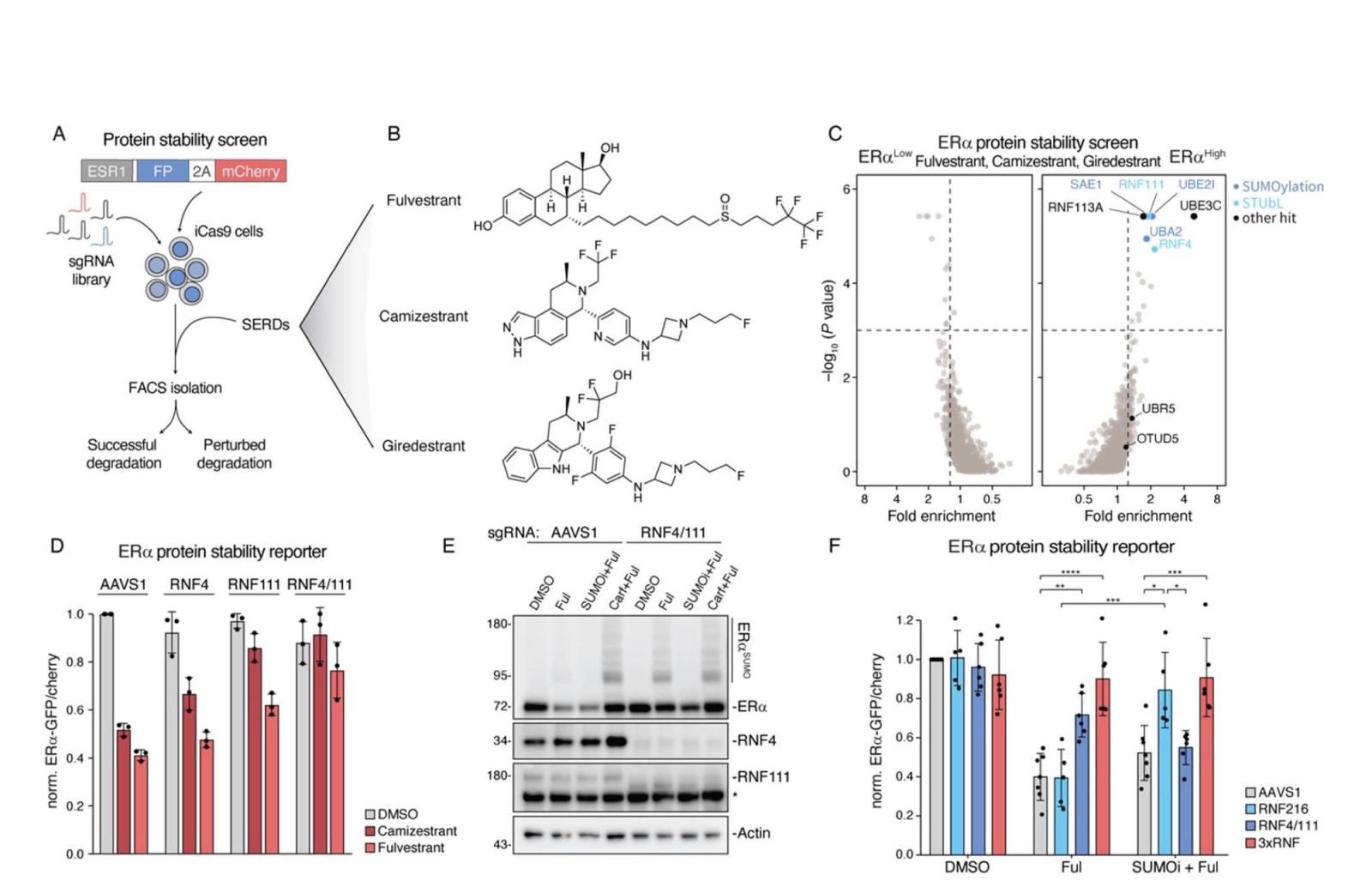
A recent preprint from the Thomä and Winter groups reports a mechanism that could significantly broaden how we think about induced-proximity pharmacology. Studying selective estrogen receptor degraders (SERDs), the authors show that compounds including fulvestrant, camizestrant and giredestrant directly promote SUMOylation of estrogen receptor alpha (ERα) by strengthening its interaction with PIAS-family SUMO E3 ligases.
The key finding is that ERα degradation is not the primary driver of drug activity. SUMOylated ERα recruits transcriptional co-repressors, including the NuRD complex, and is converted into a dominant-negative transcriptional repressor. In this model, the pharmacologically important event is not simply removal of the target protein, but a drug-induced change in its functional state.
The ubiquitin system enters downstream through SUMO-targeted ubiquitin ligases (STUbLs), including RNF4 and RNF111, which recognize SUMO-modified ERα and promote its degradation. Strikingly, genetic disruption of this degradation machinery does not reduce SERD efficacy. Instead, preventing ERα turnover can increase drug sensitivity, consistent with degradation removing the very SUMOylated repressive species responsible for the therapeutic effect.
From an E3-ligase and medicinal chemistry perspective, this is particularly important. Much of targeted protein degradation has been built around a relatively linear objective: induce proximity, drive ubiquitination and eliminate the target. This work suggests a broader design space in which small molecules can reprogram native protein–ligase interactions to install a functional post-translational modification, with degradation representing only one possible downstream outcome.
If validated beyond the current models, the implications could be substantial. SUMO E3 ligases and other post-translational modification systems may offer opportunities for drug discovery that extend beyond classical PROTACs and molecular glue degraders. The emerging question is no longer only whether a small molecule can remove a disease-relevant protein, but whether it can redirect that protein into a new, therapeutically useful functional state.
Read the full preprint:Induced Estrogen Receptor SUMOylation drives SERD activity