
More Binding, Less Transcription. The Molecular Paradox of DALTACs
How a new class of bifunctional molecules challenges the conventional logic of targeted protein degradation and opens a different route to controlling cancer-associated transcription.
The emergence of targeted protein degradation TPD has fundamentally changed how medicinal chemists approach disease-associated proteins. Instead of merely blocking an active site, PROTACs and molecular glue degraders exploit induced proximity to eliminate a protein altogether. Yet degradation is not always necessary - or even the most desirable outcome. Some pathological functions arise not from the presence of a particular protein, but from the way several proteins assemble and cooperate within a molecular complex.
A recent study published in Nature by Luo, Yang and colleagues introduces an intriguing alternative: domain-alteration chimeras DALTACs, bifunctional molecules designed to reorganize existing protein complexes into functionally unproductive configurations.
Rather than recruiting an E3 ubiquitin ligase to destroy a target, DALTACs impose an artificial interaction between selected protein domains, changing the geometry and biochemical behaviour of an endogenous complex. The authors demonstrate this principle in androgen receptor (AR)-driven prostate cancer, where transcriptional activity depends on cooperation between AR and the acetyltransferases p300 and CBP.
Metastatic castration-resistant prostate cancer mCRPC remains strongly dependent on AR signalling, even after resistance to androgen deprivation and AR-directed therapies develops. This dependence extends beyond receptor activation itself. AR operates within elaborate transcriptional assemblies containing chromatin regulators, coactivators and components of the transcriptional machinery. Among these partners, p300 and CBP play central roles in establishing transcriptionally permissive chromatin. Their acetyltransferase activity contributes to enhancer function, including histone H2B N-terminal acetylation (H2BNTac), which has been associated with AR-dependent transcriptional programmes.
This creates an attractive therapeutic opportunity, but also a selectivity problem. p300 and CBP participate in numerous physiological processes, making broad inhibition of their catalytic activities potentially undesirable. The central question, therefore, is whether medicinal chemistry can selectively disable the pathological AR–p300/CBP partnership without indiscriminately suppressing the functions of these proteins throughout the cell.
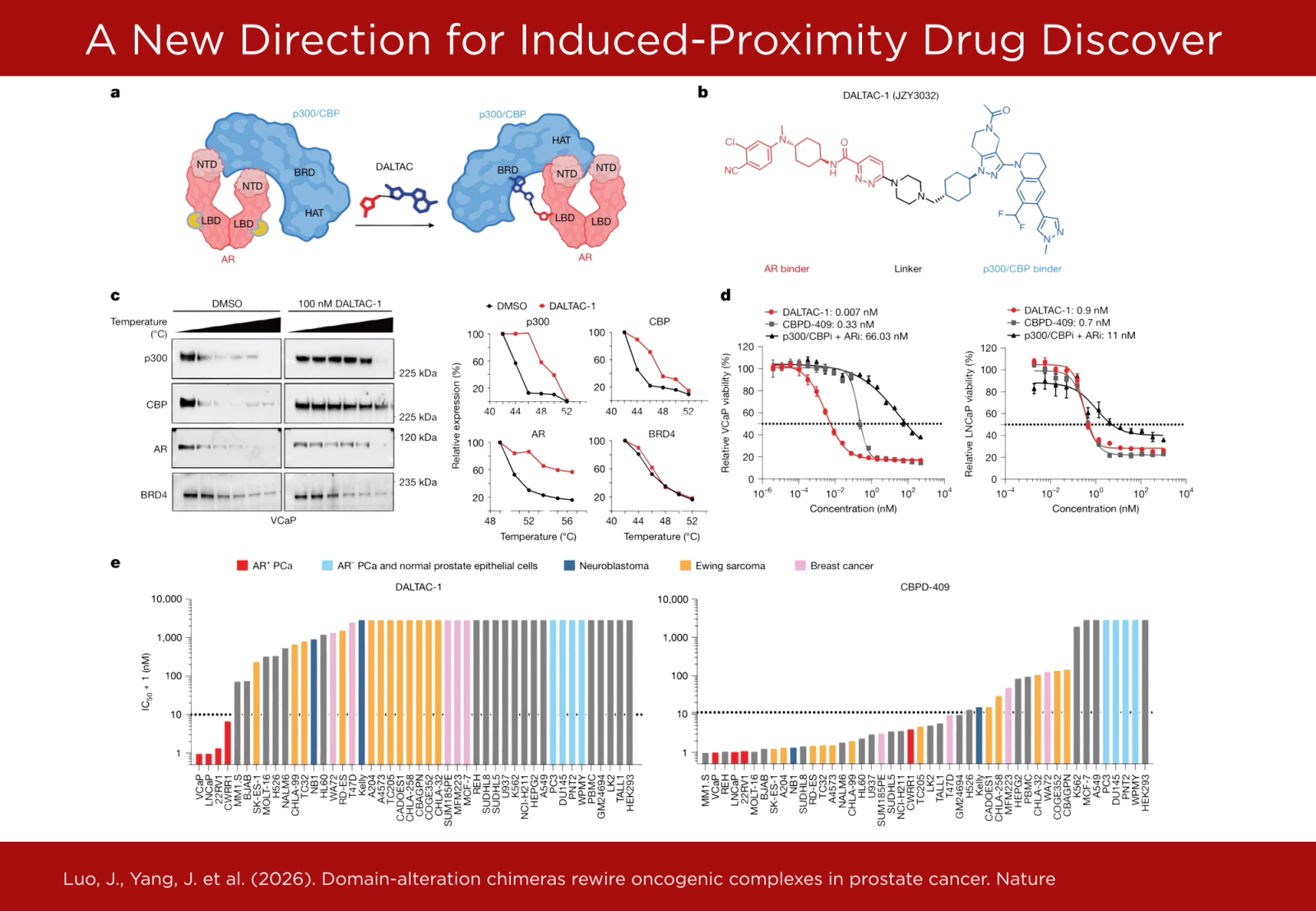
The authors developed DALTAC-1 to establish synthetic proximity between the ligand-binding domain of AR and the bromodomain of p300/CBP. Under normal circumstances, AR interacts with p300 through a different domain arrangement involving the AR N-terminal region. DALTAC-1 enforces an alternative connection, effectively changing the topology of the protein assembly.
This distinction separates DALTACs from conventional bifunctional inhibitors. Their purpose is not simply to occupy two binding sites simultaneously. Instead, the molecule imposes an unnatural spatial relationship between proteins that already cooperate biologically. The resulting complex remains associated but becomes functionally misconfigured.
Remarkably, the authors report that DALTAC-1 suppresses AR-dependent transcription and cellular proliferation more effectively than combined pharmacological inhibition of AR and p300/CBP. They describe this phenomenon as a super-inhibitory effect. The pharmacological output cannot be explained solely by the inhibitory properties of the individual binding elements. It emerges from the new protein architecture created by the bifunctional compound.
Biochemical experiments confirmed the formation of an AR–DALTAC-1–p300 ternary complex. Domain-mapping and mutagenesis studies supported the proposed non-native interaction, although the complete atomic structure of the assembly has not yet been resolved.
More unexpectedly, DALTAC-1 altered the substrate preferences of p300/CBP. Histone acetylation was strongly suppressed, particularly H2BNTac, while acetylation increased on AR and associated coactivators, including SRC2 and SRC3.
This observation suggests that enforced domain proximity can redirect enzymatic activity rather than simply inhibit it. The acetyltransferase remains present, but its productive engagement with chromatin substrates is disrupted.
Chromatin profiling provided another striking result: DALTAC-1 increased AR and p300 occupancy at certain androgen response elements while simultaneously reducing the recruitment of BRD4, ERG and RNA polymerase II. Greater occupancy did not translate into stronger transcription. Instead, the altered complex became incapable of sustaining the oncogenic programme.
Protein abundance, target engagement and biological function are not interchangeable measurements. DALTAC-1 demonstrates that a protein complex can remain physically assembled yet lose the molecular organization required for its activity. The biological results are substantial. DALTAC-1 demonstrated pronounced antiproliferative activity in AR-positive prostate cancer models, including cells expressing the AR-V7 splice variant.
In VCaP cells, the reported five-day viability IC₅₀ was 0.007 nM, compared with 0.33 nM for the p300/CBP degrader CBPD-409 and 66.03 nM for the combination of the corresponding AR and p300/CBP inhibitors. These exceptionally low cellular values are encouraging, although their translation into clinically achievable efficacy remains to be established.
Importantly, the compound showed much weaker activity in AR-negative cellular models, supporting the hypothesis that its pharmacology depends on the simultaneous presence of the relevant protein partners.
The in vivo findings reinforce this mechanism. In a castration-resistant VCaP xenograft model, intraperitoneal DALTAC-1 treatment produced tumour regression in 12 of 16 tumours. Additional patient-derived xenograft experiments demonstrated sustained antitumour responses, including activity exceeding that of the AR degrader ARV-766 in a tested model.
The reported tolerability was favourable in these preclinical studies, without significant alterations in the monitored haematological, hepatic or renal parameters. Nevertheless, these observations cannot substitute for comprehensive toxicology or establish clinical safety.
DALTAC-1 is particularly interesting because its discovery follows a familiar molecular design strategy but produces an unfamiliar pharmacological outcome.
The molecule combines an AR-binding element with a p300/CBP bromodomain ligand derived from GNE-049. Optimisation of the bifunctional architecture led to JZY3032, subsequently designated DALTAC-1.
Despite a molecular weight of approximately 975 Da, the compound achieved 18.5% oral bioavailability in mice. This is a noteworthy result for a molecule operating well beyond conventional small-molecule physicochemical space, although further optimisation of exposure, distribution and developability will be essential.
The broader challenge is understanding how to design such molecules predictably. For PROTACs, medicinal chemists have learned that ternary-complex cooperativity, linker geometry, protein surface complementarity and productive ubiquitination can be more important than binary affinity alone. DALTACs introduce another dimension - the imposed geometry must change the functional organisation of a pre-existing complex.
This creates opportunities for structure-guided design, but also raises demanding questions. How broadly can domain-level rewiring be applied to other transcriptional assemblies? Can the desired conformation be predicted from structural models? Will resistance arise through changes in ligand-binding pockets, protein interfaces or compensatory transcriptional networks?
Equally important, DALTACs will require pharmacodynamic assays that measure complex function rather than target disappearance. Quantitative proteomics, acetylomics, chromatin occupancy and transcriptional profiling may be particularly valuable for distinguishing genuine complex reprogramming from ordinary dual inhibition.
The development of PROTACs established that induced proximity could redirect cellular machinery towards protein elimination. Molecular glues demonstrated that relatively compact molecules could stabilise new protein interfaces. Other proximity-based approaches have since expanded the possibilities to include transcriptional activation, relocalisation and selective interference with essential cellular functions.
DALTACs add a distinct principle: a disease-associated protein complex can potentially be therapeutically disabled by changing how its existing components interact.
The approach remains at the preclinical proof-of-concept stage. Its generality across different protein complexes, long-term safety and therapeutic advantages over established modalities have yet to be demonstrated.
Nevertheless, the conceptual advance is substantial. It shifts attention from individual proteins towards the functional architecture of multiprotein assemblies, where relatively small changes in molecular geometry can produce profound biological consequences.
References
- Luo, J., Yang, J. et al. (2026). Domain-alteration chimeras rewire oncogenic complexes in prostate cancer. Nature. https://doi.org/10.1038/s41586-026-11262-4
- Tsai, J. M., Nowak, R. P., Ebert, B. L. & Fischer, E. S. (2024). Targeted protein degradation: from mechanisms to clinic. Nature Reviews Molecular Cell Biology, 25, 740–757. https://doi.org/10.1038/s41580-024-00729-9
- Hsia, O. et al. (2024). Targeted protein degradation via intramolecular bivalent glues. Nature, 627, 204–211. https://doi.org/10.1038/s41586-024-07089-6
- Hinterndorfer, M., Spiteri, V. A., Ciulli, A. & Winter, G. E. (2025). Targeted protein degradation for cancer therapy. Nature Reviews Cancer, 25, 493–516. https://doi.org/10.1038/s41568-025-00817-8
- Proteome-scale discovery of protein degradation and stabilization effectors. (2024). Nature, 628, 878–886. https://doi.org/10.1038/s41586-024-07224-3