Rebuilding a Carboxylic Acid Into a Lysine-Reactive Warhead
eIF4E and the cap-binding site
eIF4E binds the 7-methylguanosine cap at the 5′ end of mRNA and, together with eIF4G and eIF4A, assembles the eIF4F complex through which ribosomes are recruited; it also exports a subset of transcripts from the nucleus. Initiation is rate-limiting for the messages that depend most heavily on it, so raising eIF4E activity raises the output of cyclins, survival factors and drivers of invasion disproportionately, and that disproportion is why eIF4E has drawn attention as a point of intervention rather than the pathways below it.
The site itself has been the obstacle. It evolved to read a polar, polyanionic ligand, so the compounds that mimic it best are charged, poorly permeable and difficult to develop, and the cap analogues built through the 1990s and 2000s never escaped that constraint. Work on the eIF4E–eIF4G interface has produced useful tool compounds without yielding anything that combines potency with cellular activity, and eIF4E is now routinely cited as the example of an RNA-binding protein that small molecules do not reach.
Lysine as a covalent target. A covalent approach would sidestep part of the affinity problem, since a slow reaction can compensate for modest reversible binding, but there is no cysteine near the cap site to react with. Lysine is the available alternative and a considerably more awkward one. The ε-amino group has a pKa around 10.5 and is therefore almost entirely protonated at pH 7.4, and an ammonium ion will not attack an electrophile. Raising the reactivity of the warhead solves this on paper and creates a worse problem in practice, because lysine is among the most abundant residues in the proteome and a reactive electrophile will label it wherever it is accessible.
Selectivity has to come from the complex instead. Wan and co-workers showed in 2020 that this is achievable for eIF4E, using covalent docking against a make-on-demand library to find arylsulfonyl fluorides that modify Lys162, a non-catalytic residue at the rim of the cap site, and obtaining the first covalent eIF4E inhibitor with activity in cells. Sulfonyl fluorides are intrinsically reactive, however, and in that series the burden of selectivity falls almost entirely on the reversible complex that precedes the reaction.
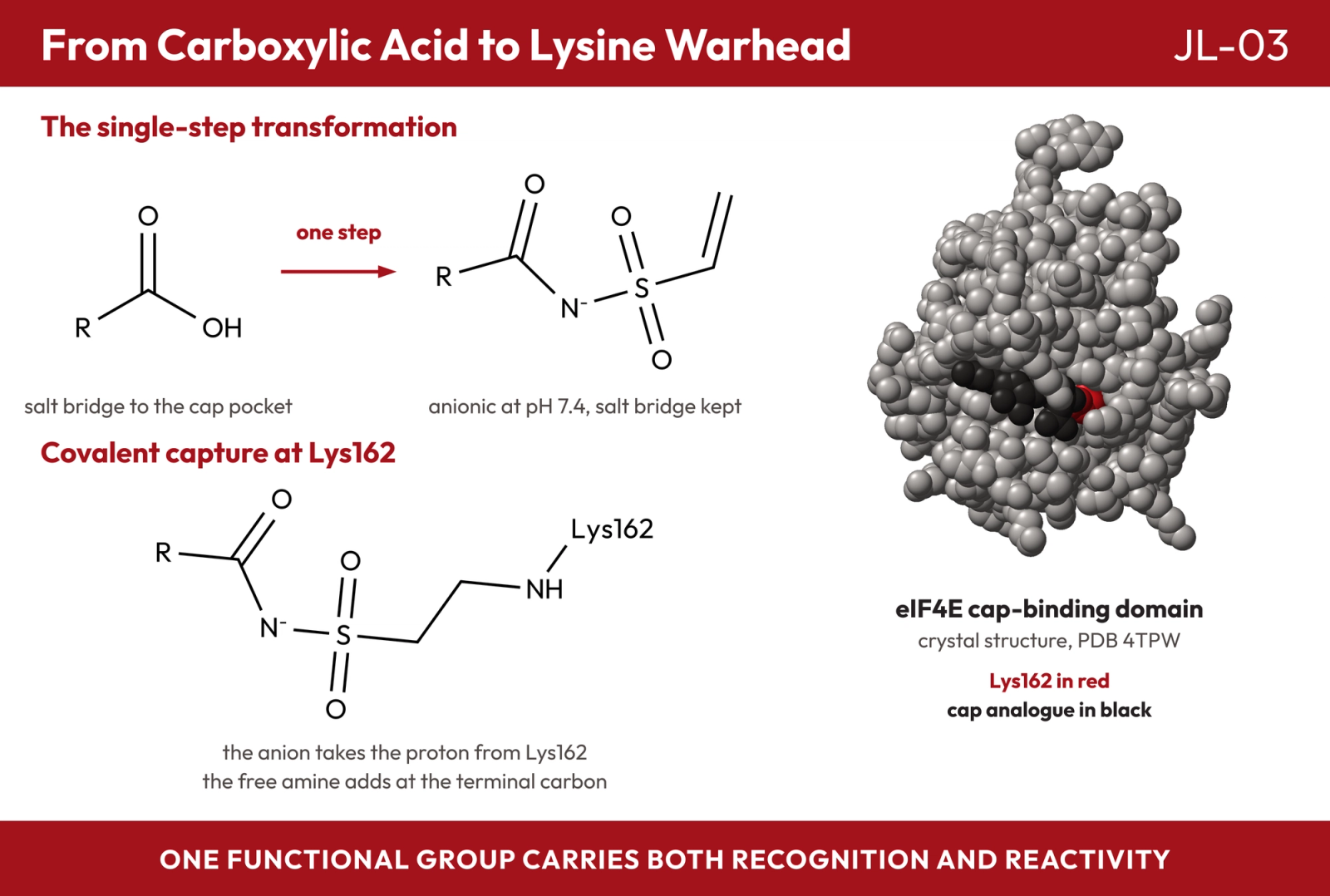
The acylsulfonamide warhead. The route taken by Pal and co-workers keeps the reversible complex and changes only the group at its centre. Acylsulfonamides are long-established carboxylic acid bioisosteres: the N–H has a pKa near 4, so the group carries a negative charge under physiological conditions and presents the pocket with much the same electrostatics as the parent acid. Because the coupling partner is ethenesulfonamide, the sulfonyl arrives with a vinyl group already attached, and the Michael acceptor is therefore built into the recognition element rather than appended to it.
What follows from that arrangement is more than economy of synthesis. In the mechanism the authors draw, the sulfonamide anion removes a proton from the Lys162 ammonium ion, and the free amine that results adds to the terminal carbon of the vinyl sulfone. A single group holds the molecule in position, generates the nucleophile and then captures it. The polar contacts shown in the graphical abstract run from the pocket to both sulfonyl oxygens and to the carbonyl as well as to the anionic nitrogen, so recognition is distributed across the whole warhead rather than resting on one ion pair.
Reactivity in solution and in the pocket. JL-03 is reported to be stable toward biological nucleophiles, which for a Michael acceptor deserves comment. A vinyl sulfone carrying an adjacent anion is a poor electrophile in free solution, because approach by glutathione thiolate is electrostatically disfavored and the negative charge lowers the electron demand at the carbon under attack. Once the ligand is bound the same charge works the other way, pairing with a cationic residue and sitting in position to act as a base. Reactivity is conditional on binding rather than intrinsic to the group, which is the behavior one wants from a lysine-directed electrophile and the reason the series is worth following.
That conditionality also changes how such compounds should be assessed. A glutathione half-life measures precisely the property the design suppresses and will report a context-activated warhead as inert; the informative number is kinact/KI, which separates the reversible affinity that positions the electrophile from the rate of bond formation once it is in place. Neither value appears in the abstract, and both will govern how the compound behaves as free drug clears between doses.
Activity in leukemia cells. The cellular data follow the chemistry. JL-03 shows target engagement in cells and lowers translation of cyclin D, a protein whose message is particularly sensitive to the efficiency of cap-dependent initiation. Against HOXA9-high acute myeloid leukemia lines it is more potent than the reversible eIF4E inhibitors run alongside it, which is the comparison that matters, since it asks whether covalent engagement delivers anything that sustained occupancy would not.
The combination data are the more interesting part. JL-03 synergizes with the menin inhibitor revumenib, and the two mechanisms are complementary in a way that is easy to rationalize, since menin inhibition dismantles the transcriptional program on which HOXA9-driven leukemias depend while eIF4E inhibition attacks the same dependency after transcription. Synergy in cell lines says nothing yet about a therapeutic window, but a combination with a mechanistic rationale behind it is a better starting point than one found empirically.
eIF4E has a mixed record as a degradation target, and the two relevant studies reach opposite conclusions for instructive reasons. Fischer and co-workers reported a biphenyl inhibitor, i4EG-BiP, that binds an internal site and displaces eIF4G, and built CRBN-recruiting PROTACs from it and from 4EGI-1. Those compounds bound eIF4E and engaged CRBN but did not degrade it, which the authors attributed in part to competition from 4E-BP1, whose association with eIF4E their own inhibitor increased. Wicks and co-workers later showed that eIF4E can be degraded, using peptidic degraders they call eIFTerminators that recruit the E3 ligase CBL; eIFTerminator4 cleared endogenous eIF4E through both proteasomal and lysosomal routes, although it also lowered eIF4A and eIF4G and reduced global translation. Together the two papers indicate that eIF4E is degradable, that the ligase and the geometry of the ternary complex decide whether degradation happens, and that selectivity is not assured once it does.
Whether the JL-03 chemotype could serve as a handle for a degrader is an open question rather than a claim made in the paper. The recognition features are attractive, but an irreversible bond to the protein of interest sits awkwardly with the catalytic logic of a PROTAC, which depends on binding, ubiquitination and release repeating. Covalent attachment does not prevent degradation, as several series have shown, though it removes the turnover that lets degraders work at sub-stoichiometric exposure, and a linker vector preserving the geometry of the cap pocket would still have to be found. Reversible-covalent or non-covalent analogues retaining the same recognition elements would avoid the first difficulty. The other option is to move the covalent chemistry to the ligase, as in the synthetic RNF114 recruiters described by Luo and co-workers, which degraded BRD4 and BCR-ABL through covalent engagement of the E3 and showed that the consequences of forming a bond depend on which half of the molecule forms it.
The paper establishes is that an anionic recognition group can be rebuilt as a lysine-reactive warhead without losing the interactions that made it worth keeping, and that the result is selective and stable enough to work in cells. The tactic should generalize, though narrowly: it needs an existing ligand that binds through an acid, a lysine within reach of that acid, and a geometry in which the new electrophile points toward the amine rather than away from it. Each condition is easy to state and harder to satisfy, and proteome-wide selectivity will have to be established separately for every series that attempts it.
For JL-03 the obvious next steps are kinetic characterization, lysine chemoproteomics in a relevant cellular background, and some measure of how long target engagement persists once free compound has cleared, since covalent inhibition decouples the duration of effect from circulating concentration and makes the resynthesis rate of eIF4E the variable that sets the dosing interval. None of that is in the present paper, which is a chemistry paper with a cellular endpoint rather than a preclinical package, and it reads as one.
References
Pal, P.; James, E. M.; Given, C. E.; Yue, H.; Metivier, R. J.; Che, J.; Fischer, E. S.; Jones, L. H. Lysine-Targeted Covalent Inhibition of eIF4E with an Anionic Electrophile Warhead. ACS Chem. Biol. 2026, published online 3 November 2026. 10.1021/acschembio.6c00714
Related publications
1. Wan, X.; Yang, T.; Cuesta, A.; Pang, X.; Balius, T. E.; Irwin, J. J.; Shoichet, B. K.; Taunton, J. Discovery of Lysine-Targeted eIF4E Inhibitors through Covalent Docking. J. Am. Chem. Soc. 2020, 142, 4960–4964. 10.1021/jacs.9b103772.
2. Fischer, P. D.; Papadopoulos, E.; Dempersmier, J. M.; et al. A Biphenyl Inhibitor of eIF4E Targeting an Internal Binding Site Enables the Design of Cell-Permeable PROTAC-Degraders. Eur. J. Med. Chem. 2021, 219, 113435. 10.1016/j.ejmech.2021.1134353.
3. Wick, A. T.; Buetow, L.; Suzuki, T.; et al. CBL Ubiquitin Ligase Targets Translation as a Degrader E3. Chem. Sci.2026, 17, 4061–4074; published online 26 December 2025. 10.1039/D5SC06141E
4. Luo, M.; Spradlin, J. N.; Boike, L.; et al. Chemoproteomics-Enabled Discovery of Covalent RNF114-Based Degraders That Mimic Natural Product Function. Cell Chem. Biol. 2021, 28, 559–566.e15. 10.1016/j.chembiol.2021.01.005