BTK degraders are designed to eliminate the entire protein rather than simply occupy its kinase domain. This distinction matters because BTK also supports signaling through kinase-independent scaffolding functions. Such functions can remain active in certain BTK mutants even when catalytic activity is impaired, as demonstrated by Montoya and colleagues in Science (2024).
Degradation can address both functions, but it introduces another vulnerability: successful ubiquitination requires a functional E3 ligase complex.
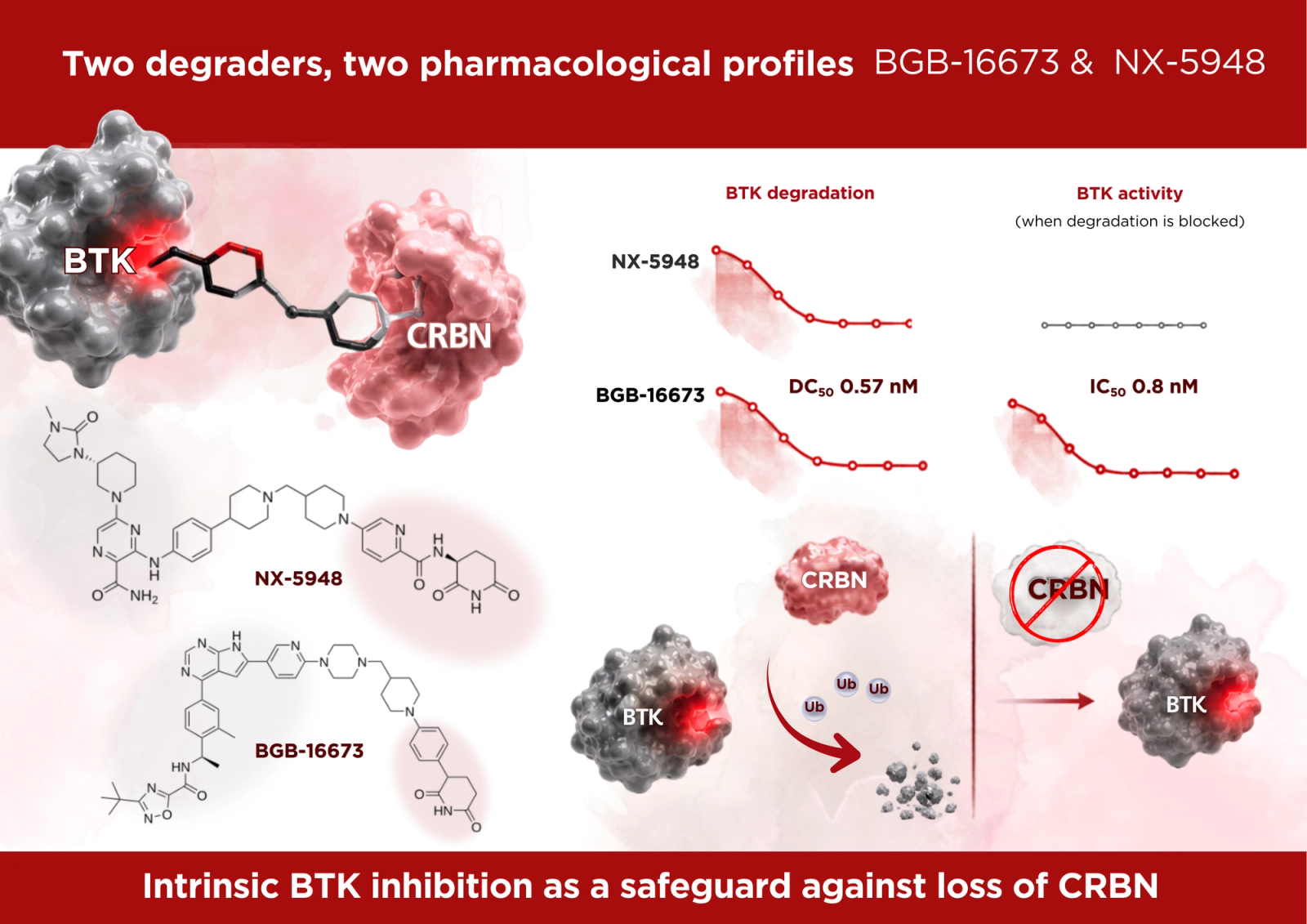
In the ASH 2026 study, BGB-16673 induced rapid BTK degradation with a DC₅₀ of 0.57 nM. NX-5948 showed comparable degradation potency. Their differences became apparent only when researchers deliberately interrupted CRBN-dependent degradation.
Using lenalidomide to block CRBN recruitment, the investigators measured BTK-Y223 phosphorylation as a readout of residual kinase activity.
BGB-16673 retained potent inhibition with an IC₅₀ of 0.8 nM. NX-5948 showed minimal inhibitory activity under the same conditions.
The experiment separates two pharmacological contributions that are normally difficult to distinguish: suppression of signaling through protein removal and suppression through direct kinase inhibition.
What happens when CRBN is lost?
The investigators extended this comparison to genetically modified lymphoma models. CRBN knockout conferred resistance to NX-5948 but not to BGB-16673. The latter also retained antiproliferative activity against a broader panel of BTK mutations, including variants associated with reduced NX-5948 activity.
Spontaneously selected NX-5948-resistant clones carrying CRBN loss or truncating alterations remained sensitive to BGB-16673.
The difference persisted in mouse xenograft experiments. Loss of CRBN or introduction of the BTK-M477P mutation abolished the reported antitumor activity of NX-5948, whereas BGB-16673 maintained significant efficacy.
These observations support a dual-mechanism interpretation: when degradation is unavailable, intrinsic BTK inhibition can preserve part of the compound’s pharmacological activity.
Importantly, inhibition is not equivalent to degradation. A compound that blocks BTK kinase activity without removing the protein cannot be assumed to suppress its kinase-independent functions.
Resistance is becoming a medicinal chemistry parameter.
The vulnerability of PROTACs to E3 ligase alterations is not new. Zhang and colleagues reported resistance to BET-targeting PROTACs caused by changes in E3 ligase complex components in 2019.
Another approach was demonstrated by Schröder and colleagues in Nature Communications (2024). Their DCAF1-recruiting BTK degrader, DBt-10, remained active in cells resistant to CRBN-based BTK degraders. Rather than preserving direct target inhibition, this strategy changes the recruited E3 ligase.
The new BGB-16673 findings introduce a complementary design option: retain strong binary target inhibition as a secondary mechanism within a degradation-competent molecule.
This expands the evaluation of degrader candidates beyond DC₅₀ and Dmax. During lead optimization, it becomes useful to measure residual kinase inhibition when CRBN recruitment or proteasomal degradation is disabled, alongside degradation kinetics, cellular target engagement, mutant coverage, and selectivity.
There is a trade-off.
Strong occupancy-driven inhibition does not reproduce all the biological consequences of protein removal. It may also alter dose–response behavior and kinase selectivity requirements. Maximizing intrinsic inhibition should therefore be a deliberate design decision, not a universal optimization rule.
CRBN knockout, selected resistant clones, and engineered BTK mutations are valuable mechanistic models, but they do not establish how frequently these resistance mechanisms will emerge in patients receiving BTK degraders.
Nor do these experiments establish superior clinical efficacy for BGB-16673 over NX-5948. Both agents have distinct pharmacological profiles and ongoing clinical development programs. What the study does establish is a useful distinction between degraders with similar degradation potency: their activity after degradation fails can be very different.
For future TPD programs, understanding that residual activity may be just as important as measuring how efficiently a compound eliminates its target under optimal conditions.