
In conventional small-molecule drug discovery, replacing a flexible chain with a ring or introducing an additional oxygen atom may be a relatively modest structural modification. In a PROTAC, the same change can alter the relationship between two protein-binding ligands, reshape the molecule’s conformational preferences, and affect cellular permeability, solubility, and degradation efficiency.
The linker is therefore considerably more than a molecular spacer. It is also one of the few regions of a bifunctional degrader that medicinal chemists can modify extensively without directly changing the recognition elements. Yet linker optimization frequently remains an exercise in preparing and testing successive analogues, with limited ability to anticipate the consequences.
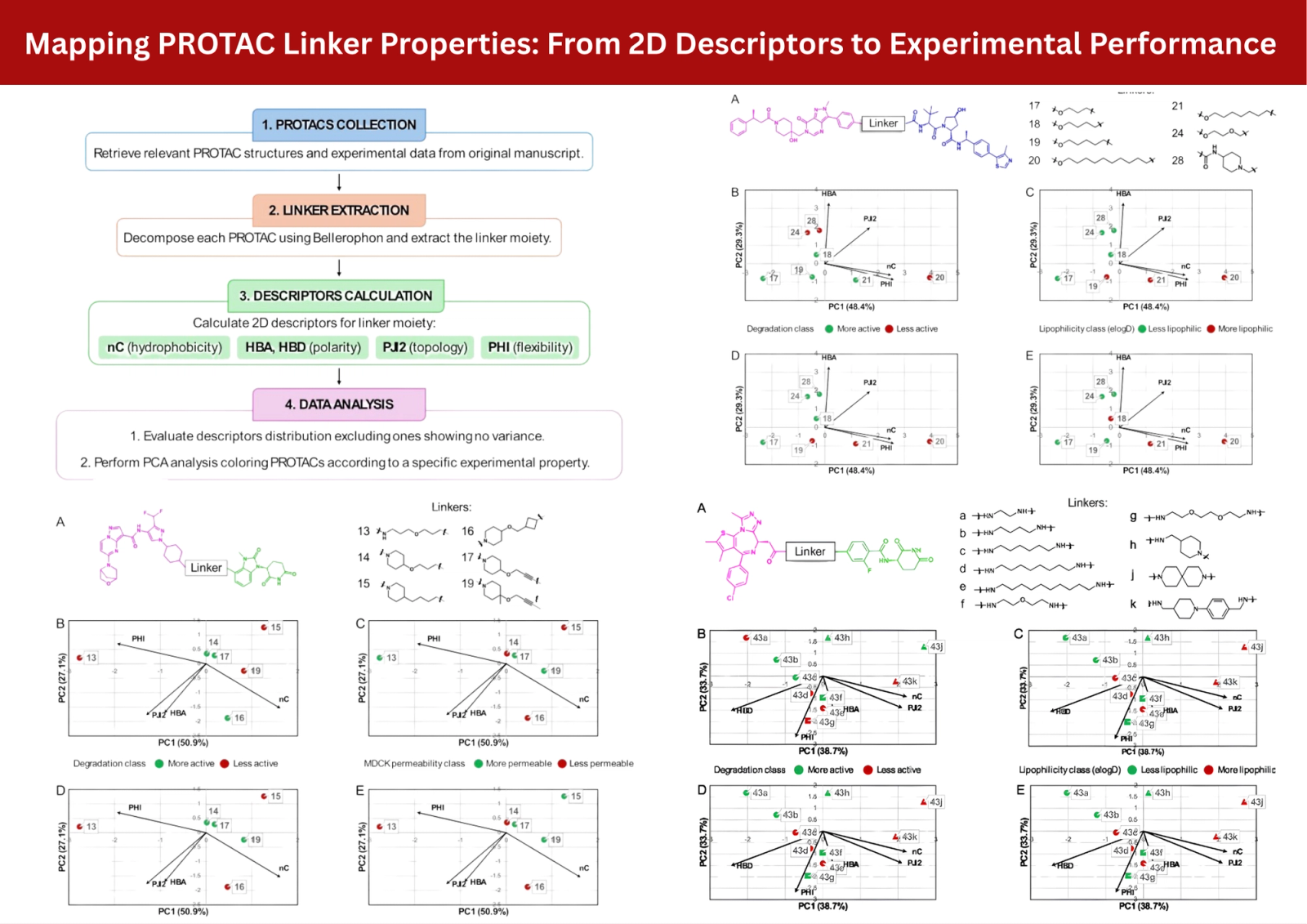
Giulia Apprato and colleagues address this problem in their recent ChemMedChem publication, “Limiting Trial-and-Error: Linker-Based 2D Descriptor Analysis to Support Very Early Proteolysis-Targeting Chimeras Design” [1]. Their approach is deliberately simple: use molecular descriptors calculated from the linker alone to identify relationships with experimentally measured PROTAC properties.
Finding useful information in five descriptors. The researchers selected 32 PROTACs from four matched series targeting ERK5, USP7, IRAK4, and BRD4. The datasets included both VHL- and CRBN-recruiting degraders, with the POI ligand, E3 recruiter, and attachment points maintained within each series.
Linkers were extracted using Bellerophon, an automated PROTAC decomposition tool previously developed by the same research group [2]. Each linker was characterized using five 2D descriptors: carbon atom count (nC), hydrogen-bond donor and acceptor counts (HBD and HBA), Kier’s flexibility index (PHI), and the Petitjean shape index (PJI2).
Together, these descriptors provide a compact representation of linker composition, polarity, flexibility, and topology. Principal component analysis (PCA) was then used to examine how linker chemical space relates to degradation and physicochemical properties.
The most informative results came from the VHL-based PROTAC series. For ERK5 degraders, whose passive permeability spans nearly three orders of magnitude in the original study by Abeje et al. [3], the descriptor analysis revealed a separation between more and less permeable compounds. Increased linker flexibility was associated with improved permeability, while greater polarity and fewer carbon atoms generally favored solubility. Some compounds displayed both favorable permeability and solubility, although the relationships were not universal.
In the USP7 series, higher HBA counts and particular linker topologies were associated with improved degradation. Meanwhile, higher carbon counts and flexibility correlated with increased lipophilicity. The relationship with aqueous solubility was less distinct.
The CRBN-based series presented a more complicated picture. For IRAK4 degraders, the five descriptors did not provide a clear separation of compounds according to degradation, permeability, efflux, or microsomal stability. In the BRD4 series, shorter aliphatic linkers generally reduced lipophilicity and plasma protein binding while improving solubility, but degradation efficiency followed a nonlinear pattern.
These differences illustrate a familiar challenge in PROTAC optimization: improving one molecular property does not necessarily improve the others. They also suggest that the usefulness of simple linker descriptors depends on the chemical context of the complete degrader.
From conformational understanding to early synthetic decisions. Several earlier studies have established the importance of linker structure in PROTAC behavior. Gadd et al. demonstrated how cooperative interactions within the ternary complex contribute to selective protein degradation [4]. Poongavanam and colleagues subsequently showed that linker-dependent folding can influence cellular permeability by changing the exposure of polar groups [5]. More recently, Abeje et al. investigated the relationship between linker composition, conformational preferences, and membrane permeability in VHL-based degraders [3].
These studies helped establish why linker modifications can have substantial biological and physicochemical consequences. Much of that understanding, however, relies on experimental and computational methods capable of examining three-dimensional conformational behavior.
The contribution of Apprato and colleagues is different. Their work moves part of the analysis to an earlier stage, where a relatively small experimental dataset and readily calculated 2D descriptors may already help prioritize linker designs.
This approach also fits the broader property budget concept discussed by Hornberger and Araujo [6]. A PROTAC’s physicochemical behavior results from the combined contributions of its POI ligand, E3 recruiter, and linker. The same linker modification may therefore produce different outcomes when transferred between molecular scaffolds.
The authors are appropriately cautious about the predictive scope of their analysis. Only 6–10 compounds were examined in each series, and the classification thresholds were selected separately for individual datasets. Although the first two principal components captured approximately 72–78% of the descriptor variance, this does not establish comparable predictive accuracy for degradation or ADME properties.
Two-dimensional descriptors also cannot describe intramolecular hydrogen bonding, environment-dependent conformations, or the molecular interactions required for productive ternary-complex formation. The absence of clear trends in the CRBN datasets should consequently not be interpreted as evidence that linker chemistry is less important for CRBN degraders.
A more deliberate starting point for linker optimization. The practical application proposed by the authors is modest but relevant. An initial set of approximately five or six structurally diverse linkers could provide enough experimental information to identify useful trends within a particular PROTAC series. Subsequent analogues could then be selected to explore promising regions of descriptor space rather than simply extend a homologous linker series.
At AKos, this perspective aligns with our approach to linker chemistry and bifunctional molecule design. Access to chemically diverse linker building blocks is important, but diversity becomes more useful when it is organized around molecular properties and experimental objectives. Differences in polarity, flexibility, rigidity, and attachment geometry should be considered deliberately when constructing early PROTAC libraries.
Apprato and colleagues have not established a universal model for selecting optimal linkers. Their study offers a simpler and potentially more accessible way to extract practical information from existing medicinal chemistry data. Its next test will be prospective application to larger datasets, where descriptor-guided selection can be compared directly with conventional linker optimization.
For medicinal chemists working with complex bifunctional molecules, even a modest improvement in the selection of the next synthetic series would be valuable.
References
- Apprato, G.; Traversa, S.; Caron, G.; Ermondi, G. Limiting Trial-and-Error: Linker-Based 2D Descriptor Analysis to Support Very Early Proteolysis-Targeting Chimeras Design.ChemMedChem, 2026, 21, e70532. https://doi.org/10.1002/cmdc.70532
- Apprato, G. et al. Bellerophon: An Automated Tool for PROTAC Decomposition.ACS Med. Chem. Lett., 2026, 17, 1043–1049. https://doi.org/10.1021/acsmedchemlett.5c00769
- Abeje, Y. E. et al. Impact of Linker Composition on VHL PROTAC Cell Permeability.J. Med. Chem., 2025, 68, 638–657. https://doi.org/10.1021/acs.jmedchem.4c02492
- Gadd, M. S. et al. Structural Basis of PROTAC Cooperative Recognition for Selective Protein Degradation.Nat. Chem. Biol., 2017, 13, 514–521. https://doi.org/10.1038/nchembio.2329
- Poongavanam, V. et al. Linker-Dependent Folding Rationalizes PROTAC Cell Permeability.J. Med. Chem., 2022, 65, 13029–13040. https://doi.org/10.1021/acs.jmedchem.2c00877
- Hornberger, K. R.; Araujo, E. M. V. Physicochemical Property Determinants of Oral Absorption for PROTAC Protein Degraders.J. Med. Chem., 2023, 66, 8281–8287. https://doi.org/10.1021/acs.jmedchem.3c00740